
Regional Assessment in the Ring of Fire Area
Terms of Reference for the Regional Assessment in the Ring of Fire area
Document reference number: 159
Prepared by the Regional Assessment Working Group
These terms of reference provide overall direction on the purpose, methodology and deliverables of the Regional Assessment in and surrounding the Ring of Fire area (the Regional Assessment) and provide the collective common understanding of the Regional Assessment Working Group's (Working Group) background, duties, and overall mandate.
A regional assessment is a planning tool used to assess the potential effects of multiple existing and potential future developments and activities in a specific geographic region to help inform decision-making.
"We need to go back to our old ways and those with this knowledge need to pass it down. If you don't carry this knowledge. Find an Elder to teach you these ways and you will be gifted with all these teachings."
Quote by Late Elder Ananias Spence, from Webequie First Nation
An Historic Step Together
These Terms of Reference for the Regional Assessment in the Ring of Fire area have been co-developed by Matawa First Nations, Mushkegowuk First Nations, Weenusk First Nation, and the Government of Canada. This Regional Assessment was triggered by the pressures for mining and related infrastructure developments and activities in and around the area known as the "Ring of Fire". This area is one which First Nations people have always relied on, cared for, and known by their own names.
In the face of changes that could impact this area and the surrounding sensitive region, this Regional Assessment is an effort to uphold First Nations' and the Government of Canada's responsibilities to make careful and informed decisions. First Nations and Canada undertake it knowing that, given the growing climate and biodiversity crises, these decisions will be globally significant.
This Regional Assessment is the first ever to be planned in partnership between First Nation Governments and the Government of Canada under the Impact Assessment Act. As such, these Terms of Reference - and the Regional Assessment to come - are a historic achievement.
This partnership-based approach followed three years of persistent efforts by First Nations to secure the Government of Canada's agreement to a regional assessment that is co-led in partnership between First Nations and Canada. These efforts were a call to the Government of Canada to advance its commitments to reconciliation through a meaningful demonstration of respect for First Nations' inherent authority regarding the future of their territories and peoples, and their right to free, prior, and informed consent. The way in which these Terms of Reference were developed reflects Canada's understanding of reconciliation.
The Terms of Reference are grounded in the Seven Requirements for a Cooperative Regional Assessment developed by First Nations (attached as Appendix 2 and 3) and as agreed to by the Minister of the Environment (the Minister) (attached as Appendix 1). These Requirements envision a regional assessment that takes a robust approach to impact assessment; respects First Nations' respective rights, jurisdictions, laws, cultures, and customs; and protects Indigenous Knowledge.
The participating First Nations and the Government of Canada share the hope that this Regional Assessment will be an important step in building the experience, trust, and capacity needed on all sides to advance Nation-to-Nation relationships, and commit to undertaking it honourably and diligently, remembering what is at stake.
The Regional Assessment will be Guided by the Following Principles
The Regional Assessment will:
- Place Indigenous values, interests and priorities at the forefront of the assessment process; These values and interests have come from the many different First Nation community perspectives and languages.
- Be collaborative, co-led and undertaken in an interdisciplinary and holistic approach that uses both Indigenous knowledge systems and western science; This process will be driven by the First Nation Partners' communities along with the guidance of the Impact Assessment Agency of Canada (IAAC). The combining of traditional values and teachings, along with western perspectives, will enrich the processes and give understanding of community processes.
- Ensure the information gathering process and analysis is founded on a shared understanding of sustainability developed between IAAC and the First Nation Partners (e.g. community-based priorities and criteria) and considers inter- and multi- generational perspectives (Seven Generation teachings).
- Intentionally contribute towards a renewed relationship between Canada and Indigenous Peoples based on the recognition of rights, respect and partnership and concrete action towards reconciliation at all aspects of community governance throughout the process.
- Provide opportunities for building and sharing knowledge, including enhancing First Nation Partners' capacity to conduct and participate in relevant studies, activities, and contributions to the final Report.
- Maximize opportunities for meaningful participation by Indigenous Peoples and communities with interests, rights and values within the area of concern, as well as the public in general, this includes experts, non-governmental organizations and any other interest groups.
- Ensure that both assessment processes and outcomes are shared transparently, making participation in the assessment and use of the assessment results accessible, while being respectful of the confidentiality of certain information.
- Ensure traditional knowledge, natural law, customs and practices are woven into and central to the Regional Assessment.
- Ensure that First Nation Partners and other Indigenous Peoples maintain the right to control access to their traditional knowledge and other material items that relate specifically to their cultural heritage.
1. Background
Indigenous Peoples of the James Bay Lowlands
The region now known by some as the James Bay Lowlands is inhabited by First Nations, and had been so inhabited long before the arrival of European settlers. The First Nations of this land lived freely, following the seasons and moving from winter settlement to summer settlement. The interconnected abundance of the land, its wildlife, plants and minerals provided for all their needs. They had everything they needed and carried on their way of life on land that was granted to them by the Creator.
The arrival of the Hudson's Bay Company in the 1600s changed the lifestyle of First Nations of the region. The Company's quest for the rich bounty of animal furs brought new tools and foods for trade. The fur trade became a means to barter for goods that made life a bit more convenient. It also caused disruptions, through settler encroachment on the territories of First Nations and disrupting the peaceful existence of the people.
After 1870, the newly formed Canadian government started a series of treaties with Indigenous Peoples across a vast expanse of territory. Starting in 1905, Treaty No. 9 was adopted across much of what today is Northern Ontario. The governments of Canada and Ontario made certain promises and commitments to the First Nation parties, which First Nations understand as ensuring respect for and providing protection for their way of life, lands and rights, and in return the Crown was provided certain rights in respect of lands and resources within the Treaty area. The collective meaning of these promises and commitments is the subject of dispute.
Among other things, the Treaty created reserves. First Nations were assured by the Crown that they would not be required to reside on reserves or to diminish their ways of life on the land, but many factors combined to effectively provoke or compel First Nations to transition to more sedentary reserve-centered lives, and this had and continues to have harsh and even tragic consequences. In addition, residential schools took the children away, which resulted in severing not only family, but the connection to the land. The 1965 Indian Welfare Services Agreement also required that families must live within the confines of the reserve in order to receive monthly rations. Many First Nation communities are still living in the reserves and settlements that were created in those days. However, the First Nation Partners also continue to know and practice their ways of life and to fight for self-determination and respect for their rights.
Inninoo Omeenikooseewin – this is the Swampy Cree way of conveying in a collective way how we view the lands. It describes in one general statement the gifts/heritage bestowed to the people. This speaks to the lands and all that can be used from it to sustain the peoples' wellbeing.
The Ring of Fire and James Bay Lowlands Region
The James Bay Lowlands are located in Ontario's far North, commencing northeast of Thunder Bay, Ontario. Part of Treaty No. 9 Territory (the James Bay Treaty), the region is a vast expanse of intact boreal forest and peatland complexes that, despite being inhabited for thousands of years, remains largely undisturbed by large-scale industrial development activities. The region is home to globally significant fish and wildlife species and is one of the largest carbon sinks on earth, which plays a critical role in global carbon sequestration, a key factor in mitigating climate change. The region is also home to one of the largest populations of Indigenous peoples in Ontario, with approximately 30,000 Indigenous people, including 34 First Nations who have called these lands home since time immemorial.
The James Bay Lowlands also possess vast deposits of chromite, copper, nickel, platinum, vanadium, and gold in an area that has come to be known as the Ring of Fire. Discovered in early 2003, the Ring of Fire is considered one of the most significant mineral deposits in Canada and its economic potential has led to a variety of proposed exploration and development projects in the area. As of 2023, there were over 31,000 mining claims in the area, covering over 5,000 square kilometers.
The first development projects proposed in the Ring of Fire area were Noront Resources' Eagles Nest Project and Cliffs Resources' Chromite Project in 2011, both of which were subject to federal and provincial environmental assessment processes. At the time, the Minister's decision to undertake a standard environmental assessment instead of an enhanced assessment by a joint review panel as requested by the First Nations led to a withdrawal of support of development in the Ring of Fire and a judicial review of Cliffs' proposed project.
As negotiations on a Regional Framework Agreement, including enhanced environmental assessment measures, were beginning between First Nations and the Government of Ontario, Cliffs announced that the Project will be placed on hold pending outcomes of the negotiations and favorable commodity prices. In 2014, the nine Matawa member First Nations and the Government of Ontario signed a Regional Framework Agreement, a community-based negotiation process meant to bring together the First Nations and the Government of Ontario to discuss an approach for development in the First Nations' traditional territories that included enhanced environmental assessment, infrastructure planning, socio-economic improvements, and revenue sharing. Negotiations were suspended in 2019 after the Government of Ontario announced its intent to fund assessments of road access projects into the Ring of Fire area.
In October 2019, Aroland First Nation recommended that the Minister authorize IAAC to conduct a regional assessment for the James Bay Lowlands area. The Minister also received requests for a regional assessment from the Wildlife Conservation Society of Canada, and Osgoode's Environmental Justice and Sustainability Clinic. In February 2020, the Minister recognized that development in the Ring of Fire area has the potential to impact Aboriginal and Treaty rights, traditional lands and resources, socio-economic conditions, health and community wellbeing and therefore a regional assessment is warranted.
Shortly after, a number of First Nations began pushing for the regional assessment to be co-led by First Nations and Canada. After a series of efforts and pushing and pulling over the next three years, in January 2023, the Minister met with First Nation leaders from Matawa and Mushkegowuk territories to discuss the requirements for a co-developed regional assessment and to commit to a co-led regional assessment process between First Nations and Canada.
2. Overview
2.1. The federal Impact Assessment Act (2019)Footnote 1, developed in consultation with many Indigenous Peoples across the country, provides an opportunity for regional assessment.
2.2. This is a region-specific assessment authorized pursuant to subparagraph 93(1)(a)(ii) of the Impact Assessment Act, and conducted in accordance with the Minister's commitment to the Seven Requirements for a Cooperative Regional Assessment and co-led process with First Nations within the Treaty No. 9 territory.
2.3. The Regional Assessment applies to an area described as the Ring of Fire, also known as Kawana ‘bi ‘kag by many First Nations, and to the traditional territories of the First Nation Partners who may be impacted by development in the Ring of Fire and surrounding area, and who hold and exercise Aboriginal and Treaty rights protected by section 35 of the Constitution Act, 1982.
2.4. The Minister received requests for IAAC to conduct a regional assessment in the James Bay Lowlands for the mining sector and related infrastructure.
2.5. The Minister recognized the importance of regional assessments in understanding the effects of existing or future developments and activities and directed IAAC to conduct a focused Regional Assessment in the Ring of Fire area in partnership with Matawa First Nations, Mushkegowuk First Nations and Weenusk First Nation.
2.6. The Minister and Chiefs of the First Nation Partners have determined that First Nation Partners and IAAC will work together on the Regional Assessment in a cooperative, respectful and effective manner, under the provisions of the Impact Assessment Act and co-developed Terms of Reference.
2.7. The Regional Assessment will focus on key environmental, social, health, cultural and economic conditions, and their interconnections, and how they may be affected by potential future development activities in the Ring of Fire and surrounding area.
"It's not business as usual. This is a new process."
Quote by Mark Bell, RA Working Group delegate from Aroland First Nation
3. What is a Regional Assessment?

Text version - Diagram
Diagram that displays the differences between an Impact Assessment and a Regional Assessment. An Impact Assessment looks at the effects associated with the development of a single project in a specific site. A Regional Assessment looks at the bigger picture - what the effects are of development for a variety of projects across a larger area or region.
Regional Assessments:
- Are a planning tool used to assess the positive and negative effects of multiple existing and future developments and activities in a specific geographic region, including cumulative effects.
- Encourage decision makers to take actions that promote sustainable development and thereby achieve or maintain a healthy environment, healthy communities and a healthy economy.
- Do not assess a specific project. They look broader than a single project to understand impacts at the regional level and provide more comprehensive analyses for greater effectiveness and efficiency in project-level impact assessments and help enhance and inform future impact assessments' decisions, and other decision-making processes related to development in the region.
- Do not replace the need for project-specific assessments, nor determine whether or not a project can advance.
- Focus on bigger effects (e.g. climate change, biodiversity, ecological integrity) which are often challenging to address during individual project-level assessments and decisions.
- Consider, assess, and make recommendations including potential follow- up actions, related to avoiding adverse bigger effects, and enhanced positive effects, with references to relevant governance body or bodies, where appropriate.
This Regional Assessment is ‘an opportunity for First Nation Communities to walk hand in hand in Indigenous ways and live in harmony with Mother Nature as per the Seven Grandfather Teachings and our natural laws.'
"RA when I translate it, it includes our traditional areas to be studied. I say waakaa'hi that's "around" and also dee'diibahii, "way around", and it encompasses everything. The way of our people and the life our people. When you talk about what's important. what is gifted to you by our traditional customs, gifted from our creator- these gifts and rights are our ways of life. That's the Ojibwe word. Gii'miinogozhiiwinaan (our Creator given gifts and rights) that's the Ojibwe word."
Quote by Fred Jacob, translator for the RA Working Group
4. Where will the Regional Assessment take place?
4.1. Given the known mineral resources and mining potential of the Ring of Fire area, the Regional Assessment will focus on existing and future development activities in this area (Development Area as outlined in Figure 1) as well as any associated infrastructure and induced development that may occur or that has occurred in the region (Assessment Area as outlined in Figure 1). "Induced" for these purposes means related in some way directly or indirectly to activities in the development area.
The assessment area includes the communities and traditional territories of the First Nation Partners and is the region most likely to experience the extent of positive and negative effects as a result of activities in the development area, as well as any associated infrastructure and induced development that may occur or that has occurred in the assessment area. Therefore, the spatial boundary of the regional assessment is large enough to consider the extent of positive and negative effects from past, present and reasonably foreseeable future development on key environmental, health, social, cultural and economic conditions and to allow for the consideration of effects in a regional context. In these Terms of Reference, "reasonably foreseeable" is ascertained from common awareness and anecdotal knowledge and does not require any degree of planning to have been carried out or any degree of certainty.
4.2. The Regional Assessment will be structured in a way that allows First Nation Partners and Indigenous Peoples the flexibility to collect information and knowledge within their communities and traditional territory and that prioritizes their own unique surroundings and circumstances. The Working Group maintains the ability to set specific study areas as needed to better capture the possible effects on assessment priorities (e.g. watershed boundaries, caribou ranges).
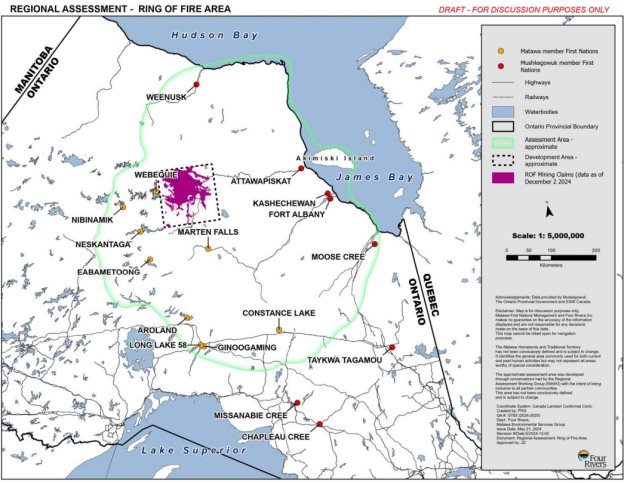
Text version - Ring of Fire development area and the Assessment Area
A map of northern Ontario shows the border of the Assessment Area which spans from just south of Highway 11 to the southern coast of Hudson's Bay and from west of Neskantaga First Nation to Moose Cree First Nation near the southern point of James Bay.
The development area where the Ring of Fire mining claims have been issued is also highlighted (mining claims data are as of December 2 2024). Around the highlighted mining claims area is a dashed-line box outlining the approximate development area for the Ring of Fire. The Development Area is approximately 100km wide and 100km tall positioned immediately east of Webequie First Nation and approximately 50km north of Marten Falls First Nation. The Matawa member First Nations as well as the Mushkegowuk member First Nations are also depicted on the map using points.
General features including provincial highways, railways, waterbodies, and the Ontario provincial boundary are also displayed on the map.
5. What is the Purpose of this Regional Assessment?
The purpose of the Regional Assessment is to provide information on key priorities of importance to the First Nation Partners and the Government of Canada, in the assessment area, and provide an analysis of the potential positive and negative effects, including cumulative and interactive effects due to possible development activities throughout the assessment area. The Regional Assessment will also Identify and provide recommendations on how the potential cumulative and other effects may best be managed to avoid adverse consequences and enhance positive ones and how (and by what governance body or bodies) the needed follow-up steps would be determined and initiated.
The Regional Assessment is intended to inform and improve the effectiveness and efficiency of future impact assessments conducted under the Impact Assessment Act and support other decision-making processes in a way that helps to:
- Preserve Indigenous ways of life, traditions, laws, customs and oral history;
- Protect and improve the environmental, health, social, cultural and economic conditions of potentially affected communities;
- Protect and advance Aboriginal and Treaty rights, claims and interests within the assessment area; and
- Create opportunities for community and regional economic equity and sustainable development.
"Up there that's my home. If you come into my home, I have rules you need to follow. I have rules that are connected to Creator and everything that lives on that land. In order for anybody or any institution to come into my home, you need to get my permission. As a community member, it affects me. […] It's highly important, our land- because that's our life. Without it we are nobody."
Quote from Fred Jacob, Translator for the RA Working Group
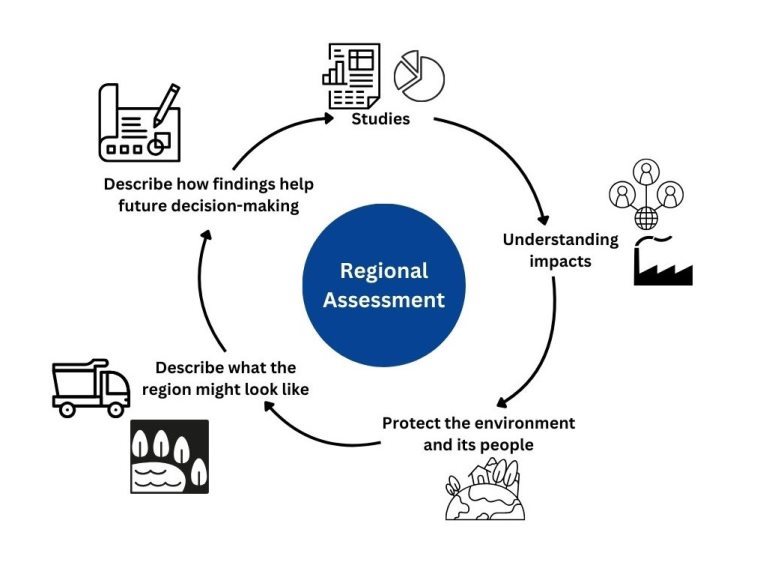
Text version - Regional Assessment Activities Diagram
Diagram illustrating, at a high level, the main cycle of activities undertaken in regional assessments. The steps in the cycle, accompanied by decorative graphics, is as follows:
- performing studies,
- understanding environmental and social impacts,
- protecting the environment and its people,
- describing what the region might look like due to development activities, and
- describing how the findings of the regional assessment can help future decision making.
6. What are the objectives of the Regional Assessment?
6.1. The objectives of the Regional Assessment are:
- Gathering and providing information and knowledge related to environmental, health, cultural, social and economic conditions and their interconnections, as well as Aboriginal and Treaty rights, claims and interests, at the regional scale:
- Provide an inventory of existing Indigenous and western technical and scientific data and Indigenous Knowledge where possible;
- Provide a description of existing conditions, including existing community socio-economic conditions and community-identified values, interests and priorities;
- Identify key information gaps and research needs that could be undertaken to support the Regional Assessment and future impact assessments and decision making, either concurrently or as part of follow-up and monitoring work; and
- Providing an understanding of potential positive and negative effects, including cumulative effects and potential impacts on Indigenous Peoples:
- Identify and describe existing and potential future development activities in the development area and associated infrastructure and induced development that may occur or that has occurred within the assessment area;
- Identify and describe components, values and concerns with respect to potential effects of development on the assessment priorities;
- Describe potential positive or negative effects, including cumulative effects, on the assessment priorities resulting from existing and potential future development activities;
- Identify potential development scenarios in the assessment area, with attention to different development intensities (e.g. status quo, low, moderate, high) and timeframes, and analyze the development scenarios to understand the potential impacts from various intensities of development on the assessment priorities; and
- Identify and describe past, present and reasonably foreseeable development activities in the assessment area that could contribute to cumulative effects.
- Identifying innovative ways to avoid, reduce or eliminate negative effects and enhance positive effects of development in a way that fosters sustainability:
- Identify ways to avoid, reduce, or eliminate negative effects or maximize the positive effects of development activities, including maximizing wellbeing and economic opportunities for Indigenous Peoples and communities; and
- Identify ways to inform planning and decision-making for future development activities, in a manner that contributes positively towards sustainability and protects sensitive areas, vulnerable populations and Aboriginal and Treaty rights, claims and interests.
- Providing regional context for future developments and their assessments:
- Provide a description of the ecological and cultural significance of the region and its people;
- Provide a description of areas of sensitivity or value-rich geographical /ecological zones;
- Describe the existing regulatory framework and identify areas for enhanced decision making for Indigenous Peoples;
- Identify potential regional and community development objectives, outline and evaluate development scenarios and potential management regimes, including governance models that abide by community protocols and decision making, to achieve positive development outcomes; and
- Develop and recommend a framework for considering and evaluating the effects of future development activities and scenarios (especially with respect to cumulative effects and ecological integrity), including criteria or indicators that may be used to evaluate the immediate and long-term effects of development.
- Describing how the findings of the Regional Assessment should be considered and implemented to enhance the effectiveness and efficiency of future decision-making processes:
- Describe how the findings of the Regional Assessment should be used to enhance the effectiveness and efficiency of future impact and cumulative effects assessments and various decision-making and monitoring or management processes; and
- Describe how the findings of the Regional Assessment should be used to inform regional and community initiatives, including governance and management.
"I come back to the relationship with the land, relationships between people and the land and how people are part of the land, from a traditional point of view. The moose and the beaver won't come to the meeting. That's our part of the relationship. What did the beaver say about this? That relationship- we look after the land and the land looks after us. How can we apply that into this process?"
Quote by John Turner, RA Working Group delegate from Moose Cree First Nation
7. What are Assessment Priorities?
Assessment priorities represent key environmental, health, social, cultural and economic conditions, and their interconnections, that may be affected due to development activities and their contributions to interacting cumulative effects and reflect the priorities and values of First Nation Partners and the jurisdictions of the federal government.
7.1. The Regional Assessment will identify and consider the potential positive and negative effects of existing and future development activities, including interactive and cumulative effects and their long-term impacts (e.g. legacy issues) whether it be social or environmental, on key environmental, health, cultural, social and economic conditions, as well as impacts on Indigenous Peoples and their Aboriginal and Treaty rights, including intra and intergenerational values.
7.2. The spatial and temporal boundaries used in the assessment may vary as appropriate, depending on the assessment priority (e.g. with respect to woodland caribou, the spatial and temporal boundaries should be broad enough to assess the impacts of development activities on woodland caribou habitat and populations).
7.3. The Regional Assessment will also consider the intersection of sex and gender, including impacts on Indigenous women, men, boys, girls and two-spirited individuals, as it relates to the assessment priorities described below.
7.4. The list of assessment priorities may be modified as appropriate by the Working Group, following dialogue with First Nation community members, cultural and spiritual advisors, and engagement with Indigenous Peoples and organizations, the public, government departments and non-government organizations.
7.5. The assessment priorities will include:
- To be well together (Community wellbeing)
- Community safety (especially for Indigenous women, men and youth)
- Family, youth and children
- Housing and Infrastructure
- Education
- Food Security
- Economic development and livelihoods
- Community health, including exceptional needs, mental, emotional and physical wellbeing
- Cultural and spiritual wellbeing
- Physical and cultural heritage, including burial sites
- Cultural vitality and traditional practices, including traditional food and medicine
- Continued way of life and exercising Aboriginal and Treaty rights
- Community-based teachings, including oral history
- Language maintenance and revival
- Traditional community processes for deliberation and decisions
- Exercise of natural law
- Social and Economic Equity
- Intra and intergenerational values
- Social and economic conditions, including immediate and long-term social and economic benefits
- Diverse economies and livelihoods
- Indigenous Women, girls and two-spirit individuals
- Current use of lands and resources for traditional purposes, including access to land and resources
- Access to skill development and economic opportunities
- Healthy Environment Relationships
- Water and river systems, including flows
- Wildlife and wildlife habitat, including species at risk, migratory birds, and fish and fish habitat
- Peatlands and other unique environments
- Forest ecosystems, including plants
- Climate change adaptation
- Biodiversity
- Air quality
"The RA process is a study specifically of those that may be impact by projects. Fn have very similiar concerns and fears that may be caused by potential development. We are always focused on the long term impacts whether be social or environmental impacts. We want to be able to protect our way of life and practice at the same time be sustainable. It's the fears and concerns that begin to define the regional assessment and being selective on specific studies that would be required. There will always be uncertainty on these regional project undertakings. If we don't address these through mitigation it will affect our decision making."
Quote by Gordon Wabasse, RAWG delegate from Webequie First Nation
"Natural law is really important in our way of life, in how we do things. Those laws are important, and they can't be broken. Is there any way we can mitigate the things the government gives us? How do we mitigate it to reflect what we need as a community member or as an Elder? How do we mitigate all the activities that we do as native people? To correct the wrongs that will be happening to our way of life. How do we mitigate the laws that are inflicted upon us? Licensing and all that, including online staking. How do we change all that to make sure my heart is ok? Things are going to change. The environment, air, waakaa'hi, and our future grandchildren will see all of this."
Quote by Fred Jacob, Translator for the RA Working Group
"We have to understand we have been living the cumulative effects of the policy of welfare and all those impacts on our communities. We are living those impacts today. […] We have issues and challenges in the communities. We were forced to live on the reserve. We are still here, and we still use the land. People are getting back to practicing the old way. Exercising the old ways. They are becoming stronger and stronger."
Quote by Mike Metatawabin, RAWG delegate from Fort Albany First Nation
"Communities are all different. Some communities are focused on road development and some on different aspects. We acknowledge all the communities, the traditional lands. We have looked at what we want to study and bring out our concerns. […] We have our own ways and the stuff we want to look at."
Quote by Mark Bell, RAWG delegate from Aroland First Nation
8. Operational Structure
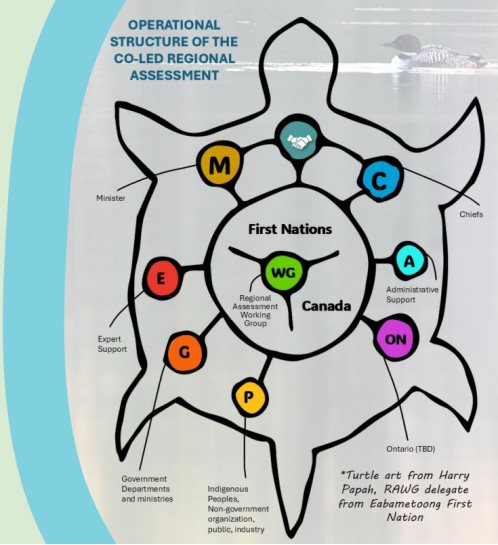
Text version - Operational Structure of the Co-led Regional Assessment
The Operational Structure of the Co-led Regional Assessment depicted using a turtle graphic.
The middle of the turtle's shell shows a symbol for the Regional Assessment Working Group which consists of the fifteen partnered First Nations and employees for the government of Canada.
The next circle of the turtle's shell has symbols representing the agreement between the Minister of Environment and Climate Change Canada and the First Nation Chiefs. Sprouting out of the turtle's outer ring are other parties contributing to the Regional Assessment including:
- Expert Supports;
- Government Departments and ministries;
- Indigenous Peoples, Non-government organizations, public, industry;
- Administrative Support;
- the province of Ontario (TBD).
*Turtle Art from Harry Papah, RAWG delegate from Eabametoong First Nation.
8.1. Regional Assessment Working Group
A Working Group will be established to conduct the Regional Assessment and will consist of community members from each First Nation Partner and representatives from IAAC, and who have diverse expertise or experience relevant to conducting regional assessments or knowledge of Indigenous and First Nations context, including the context of the First Nation Partners' communities and customs.
The Working Group will:
- Identify the appropriate protocols and customs from the Working Group to inform and guide the operations and activities including involvement of Elders and Knowledge Holders.
- Collect information and knowledge for the Regional Assessment and create an accessible platform that will store information and knowledge to ensure information is available and accessible to communities and the public.
- Generate a Report for Chiefs of the First Nation Partners and the Minister that shares findings and recommendations and will include a preliminary (interim) report.
- Meet regularly to carry out work related to the Regional Assessment. Reasonable efforts must be made to arrange meetings to accommodate all members, provide advance notice and take into consideration the timing of traditional practices.
- Conduct additional studies as it deems necessary to carry out its duties within the overall timeframe of the Regional Assessment. Information gathering and research methodology used by communities will includes Indigenous ways of knowing and being.
- Submit updates at key milestones, to be determined in the workplan, to the Chiefs of the First Nation Partners and IAAC during the conduct of the Regional Assessment and post to the Canadian Impact Assessment Registry (Internet Site).
- Seek information and advice from community members and representatives of federal and provincial governments, industry, Indigenous and non-governmental organizations and individuals (both Indigenous and non-Indigenous) on matters relevant to the conduct of the Regional Assessment.
- Ensure that, subject to exceptions and safeguards for confidential Indigenous knowledge and information, the information that it uses when conducting the Regional Assessment is made available to First Nation communities, Indigenous Peoples and the public, including public announcements, submissions and comments received during the Regional Assessment. The Internet Site will be maintained by IAAC during the conduct of the Regional Assessment in a manner that provides convenient access to information used in the conduct of the Regional Assessment
8.2. First Nation Partner Communities
- The Regional Assessment must be community-focused and include mechanisms for community dialogue and meaningful involvement of First Nation Partner community members living on their traditional territory or elsewhere. The Regional Assessment will be reflective of the different potential positive and negative effects that development activities may have on each First Nation Partner community.
- Communications in First Nation communities must be accessible to speakers of Ojibway, Oji-Cree and Cree, and materials used for the conduct of the Regional Assessment must be presented in a format which is appropriate for the audience and substance of the information being communicated (e.g., oral, video, written).
8.3. Administrative support
- Administrative support will include staff from Matawa and Mushkegowuk Tribal Council and IAAC to provide logistical, administrative and technical support for work carried out by the Working Group during the conduct of the Regional Assessment.
- The Working Group will hire an experienced independent facilitator to provide facilitation and administrative support to the Working Group throughout the conduct phase.
8.4. Chiefs of the First Nation Partners and the Minister
- Chiefs of the First Nation Partners and the Minister will seek opportunities to meet to discuss the findings and recommendations in the final Report.
- The Minister will provide a written response to the findings and recommendations included in the final Report, which will be posted on IAAC's Internet Site.
9. Knowledge Holders and Expert Supports
9.1. The Working Group will seek knowledge and perspectives from Indigenous Peoples on matters relevant to the conduct of the Regional Assessment. The Working Group will acknowledge and seek the unique and important information and advice from Indigenous Elders and knowledge holders, Indigenous youth, women, men and community members will also be included.
9.2. The Working Group will ensure opportunities are provided to allow First Nation Partners' community members to share information, knowledge and perspectives relevant to the Regional Assessment, in a manner that respects and values their relationship to the land, and to bring forward and share traditional knowledge, information and perspectives in a collaborative manner. The timing, format (e.g. Sharing Circle, Gathering and other ways of knowledge transfer) and how its outcomes would be documented and provided to the Working Group, will be determined by the Working Group, under the guidance of Elder(s).
9.3. The Working Group will also establish and seek information and advice from several Expert Supports, including Elders, during the Regional Assessment. Expert Supports may be comprised of individuals or organizations from the public, government and non-government organizations and Indigenous Peoples and organizations, who have knowledge or experience deemed relevant to the Regional Assessment by the Working Group. An individual or organization may participate in one of more Expert supports.
9.4. Expert Supports will be identified by the Working Group, including by way of a public call for interest on IAAC's Internet Site and through other means, through which interested persons will provide information on their relevant expertise, qualifications and affiliations.
9.5. The role of these Expert Supports may vary in relation to the needs, work or expertise required and requested by the Working Group during the Regional Assessment. The Working Group may request experts and knowledge holders, as appropriate, to collaborate and share relevant knowledge or experience and make recommendations to the Working Group. The role of Expert Supports will include:
- Assisting the Working Group in identifying, accessing, analyzing and using information and knowledge that is relevant to the Regional Assessment.
- Identifying and evaluating information and knowledge gaps and recommending approaches to address these.
- Identifying, providing and supporting the use and weaving of Indigenous knowledge and scientific, technical, cultural and socio-economic information in the conduct of the Regional Assessment.
- Develop findings and recommendations for consideration by the Working Group in its Report.
9.6. Involvement as an Expert Support will not restrict any individual's or organization's participation in public and community engagement activities as part of the Regional Assessment.
9.7. In addition to participation through the above-described Expert Supports, federal authorities having specialist or expert information or knowledge with respect to the Regional Assessment will be required to make that information or knowledge available to the Working Group in an acceptable manner and within a specified period.
10. Indigenous and Public Participation
10.1. The First Nation Partners and IAAC will recognize the importance of the participation of public and Indigenous Peoples in the assessment process and provide them with the opportunity to participate in that process and the information they need in order to be able to participate in a meaningful way.
10.2. To ensure that Indigenous Peoples and organizations, the public, government and non-government organizations are provided with opportunities to participate meaningfully in the Regional Assessment, the Working Group will develop and implement a Participation Plan. This plan will emphasize that this is a transparent and open process and as such will include opportunities for their participation to contribute to the conduct of the Regional Assessment.
10.3. The Participation Plan will include procedures for handling confidential information, liaison with Expert Supports, and for developing and communicating timely and consistent key messages to Indigenous Peoples and communities and the public about the Regional Assessment.
10.4. Once completed, the Participation Plan will be posted to the Internet Site and made available to First Nation communities, and updated regularly by the Working Group, to ensure that participants are aware of planned participation approaches and upcoming activities.
10.5. Communication material that is posted to the Internet Site will be provided in both French and English [as well as in Cree, Ojibway and Oji-Cree as appropriate]
11. Schedule
|
Deliverables |
Timeline for Deliverable |
|---|---|
|
The Working Group will share the information gathered to date in the form of a shared electronic platform |
Within 12 months of the establishment of these Terms of Reference. |
|
The Working Group will develop a Work Plan that will guide the Regional Assessment, including operating procedures, timelines, meeting schedule and engagement opportunities |
Within 2 months of the establishment of these Terms of Reference |
|
Upon completion of the Regional Assessment, the Working Group will concurrently deliver its Report to the Chiefs of the First Nations Partners and the Minister |
Within 30 months of the establishment of these Terms of Reference. |
11.1. The Working Group will complete its mandate and submit its final Report to the Chiefs of the First Nation Partners and the Minister within 30 months from the establishment of these Terms of Reference.
11.2. Information gathered as part of Objective 6(a) will be made publicly available, subject to exceptions and safeguards for confidential Indigenous knowledge and information, as soon as possible and updated regularly to ensure meaningful participation in the Regional Assessment.
11.3. A draft Work Plan will be developed and posted to IAAC's Internet Site within 60 days of the establishment of these Terms of Reference.
11.4. An interim Report summarizing the findings on (i) community and regional conditions and priorities, (ii) possible development scenarios, and (iii) knowledge gaps and uncertainties identified so far in the process will be submitted to Chiefs of the First Nation Partners and the Minister within 12 months of the establishment of these Terms of Reference.
12. Final Report
12.1. The final Report will contain a description of the conduct of the Regional Assessment, a summary of public and community engagement activities and input, and the results of the Regional Assessment that address the Objectives listed in Section 6, including the components set out in Annex 2.
12.2. The final Report will be translated into Cree, Ojibway and Oji-Cree and hard copies will be made available by the Working Group to First Nation Partner communities.
12.3. IAAC will make the final Report available to the public and will advise the public that the Report is available on the Internet Site in both English and French.
12.4. The final Report will be the collective effort of the Working Group and will include a chapter by IAAC and by each First Nation Partner that includes information on current conditions in the assessment area and reflects their community's vision and priorities for sustainable development.
12.5. Each First Nation Partner, with assistance from the Working Group, administrative and Expert Supports of their choosing, will have the opportunity to draft a chapter on its community / traditional territory, including collecting required information and conducting studies.
12.6. The Working Group is responsible for reviewing these chapters and compiling them into the final Report.
12.7. The information and studies in these chapters will inform the final Report's analysis of potential positive and negative effects of existing and future development activities in the development area, as well as any associated infrastructure and induced development that may occur or has occurred in the assessment area, and will inform recommendations in the Final Report.
12.8. Once the Report has been submitted, the First Nation Partners and the Government of Canada will seek opportunities to continue to work together to determine how to respond to and implement the findings and recommendations resulting from the Regional Assessment.
13. Cooperation
13.1. The Working Group will work cooperatively and with transparency guided by the Principles (refer to page 4 – An Historic Step Together) when considering and responding to:
- Any public submissions, including questions or comments, that may be received by the Ministers or the Chiefs of the First Nations Partners or by their respective departments, agencies, council or organization during and regarding the conduct of the Regional Assessment; and
- Any request for clarification to its Terms of Reference or other related matters, including the regular status updates provided by the Working Group.
13.2. Any request by another jurisdiction to be party to these Terms of Reference will be a written request to the Chiefs and the Minister for consideration.
14. Costs
14.1. IAAC will provide adequate funding through funding programs to facilitate the partnership of First Nations Partners for the conduct of the Regional Assessment, and for continued work contemplated under these Terms of Reference, including the work in section 12.5 and Annex 2.
14.2. Funding will also be made available by IAAC to ensure meaningful participation of Indigenous Peoples and organizations, non-government organizations and individuals in the Regional Assessment through IAAC's Participant Funding Program.
15. Amending the Terms of Reference
15.1. During the conduct of the Regional Assessment, the Working Group may request that the Terms of Reference be amended by the Minister under subparagraph 93(1)(a)(ii) of the Impact Assessment Act by way of a written memorandum, and in agreeance with the Chiefs of the First Nations Partners.
15.2. Parties to the Terms of Reference may withdraw from the Regional Assessment at any time by written notice signed by the Chief of a First Nation Partner or the Minister with 30 days' notice of termination.
Annex 1: Timeline of the Ring of Fire Regional Assessment in Northern Ontario
|
Year |
Event Theme |
Event |
|---|---|---|
|
Time Immemorial |
Community |
Indigenous Peoples live in their traditional territories, what is now known as the Hudson Bay and James Bay Lowlands |
|
1493 |
Governance and Administrative |
Doctrine of Discovery Papal Bull by Pope Alexander VI |
|
1670 |
Industry |
"Rupert's Land" claimed by the Hudson Bay Company, described as the Hudson Bay Basin and encompassing 1/3 of current day Canada |
|
1763 |
Governance and Administrative |
Royal Proclamation, King George III, October 7, 1763. Rules & Protocols for Future Relations with First Nations People |
|
1791 |
Governance and Administrative |
Constitutional Act of 1791 created a new colony, dividing the old Province of Quebec into Lower Canada and Upper Canada along the present-day Ontario-Québec boundary |
|
1850 |
Community |
Robinson Huron & Superior Treaty signing |
|
1867 |
Governance and Administrative |
Canadian Confederation. The British North America Act established the Dominion of Canada with four initial provinces: Nova Scotia, New Brunswick, Quebec, and Ontario |
|
1870 |
Governance and Administrative |
"Rupert's Land" purchased from Hudson Bay Company by Canada for $1.5 million |
|
1876 |
Governance and Administrative |
The First "Indian Act" |
|
1889 |
Governance and Administrative |
Department of Indian Affairs created, placing "Indian Agents" across Canada |
|
1905-1906 |
Governance and Administrative |
Treaty 9 signing *Weenusk and Attawapiskat First Nations signed the treaty in 1930 |
|
Community |
1905 Signatories Fort Hope (Esbametoong) Marten Falls English River (Constance Lake) Port Albany Moose Factory New Post |
|
|
1906 Signatories Long Lake (#77 Ginoogaming) |
||
|
1945 |
Governance and Administrative |
Band Status recognition for Constance Lake First Nation |
|
1960 |
Governance and Administrative |
First Nations Peoples given voting rights in Canada |
|
1984 |
Community |
Mushkegowuk Council established |
|
1985 |
Governance and Administrative |
APRIL 1985 Bill C31 Amendment to the Indian Act |
|
Band status recognition for: Aroland First Nation Neskatanga First Nation Nibinamik First Nation Webequie First Nation |
||
|
1988 |
Community |
Matawa First Nations Management established |
|
1996 |
Governance and Administrative |
Report of the Royal Commission on Aboriginal Peoples completed and released |
|
2003 |
Industry |
Exploration boom begins north of Marten Falls, ON |
|
2007 |
Industry |
Discovery of large deposit of platinum, palladium, nickel, and copper |
|
Community |
Mushkegowuk Declaration of Unity |
|
|
2008 |
Industry |
Discovery of chromite in the region |
|
DeBeers Canada opens Victor Mine in Attawapiskat Homelands |
||
|
2009 |
Industry |
Cliffs resources purchase rights to chromite deposit |
|
2010 |
Community |
January: Marten falls and Webequie communities block northern air strip |
|
2011 |
Community |
January: Matawa Ring of Fire Department established |
|
Governance and Administrative |
Federal and Provincial EAs begin for Cliffs and Noront mining projects |
|
|
Ontario Ministry creates Ring of Fire (RoF) Secretariat |
||
|
United Nations adopt the United Nations Declaration on the Rights of Indigenous Peoples |
||
|
October: CEAA proceeds with Comprehensive EA |
||
|
Community |
October: Matawa removes support for RoF unless joint EA occurs |
|
|
2012 |
Industry |
Public environmental concerns arise for Noront's Eagle Nest Project |
|
2013 |
Industry |
June: Cliffs announces project will be on hold pending Regional Framework Agreement (RFA) negotiations |
|
November: Cliffs announces project will be on hold pending RFA negotiations |
||
|
2014 |
Governance and Administrative |
March: Regional Framework Agreement signed |
|
2015 |
Industry |
March: Cliffs sells chromite claims to Noront |
|
Governance and Administrative |
April: 2nd year of RFA Transfer Payment Agreements (TPA) |
|
|
2016 |
Community |
October: Matawa preliminary work on Jurisdiction Table begins |
|
2017 |
Governance and Administrative |
January: Ontario Premier Wynne agrees to establish Matawa Jurisdiction Table |
|
Premier Wynne supports construction of access road to RoF |
||
|
Community |
February: Matawa begins work on draft of Statement of Shared Commitments |
|
|
2018 |
Industry |
April: Online staking comes into effect in Ontario |
|
Governance and Administrative |
October: RFA Payment Agreements (TPA) stopped by Ontario |
|
|
2019 |
Industry |
April: Noront holds majority of claims in Ring of Fire |
|
Governance and Administrative |
August: Ontario province dissolves Regional Framework Agreement |
|
|
Community |
October: Aroland First Nation requests regional assessment |
|
|
November: The Wildlife Conservation Society requests regional assessment |
||
|
December: Osgoode Environmental Justice and Sustainability Clinic requests regional assessment |
||
|
2020 |
Community |
January: Neskantaga First Nation proposed model for an Indigenous-led RA |
|
February: Several First Nations call for a co-led Regional Assessment |
||
|
Governance and Administrative |
February: Minister of Environment and Climate Change announces Regional Assessment for Ring of Fire |
|
|
Community |
March and April: Covid-19 global pandemic starts. Some First Nations call for a pause in the Regional Assessment planning process |
|
|
Fall and Winter: Several First Nations begin discussions for regarding approaches for a co-led Regional Assessment (Fort Albany, Attawapiskat, Eabametoong, Neskantaga, Nibinamik, and Kashechewan First Nations) with Canada's agreement |
||
|
2021 |
Governance and Administrative |
December: Ontario province and IAAC circulate the Draft Agreement and Terms of Reference for comment for the regional assessment |
|
Community |
January: Indigenous groups request that the Draft Agreement and Terms of Reference be terminated |
|
|
March: First Nations learn that Canada and Ontario are working on a draft Terms of Reference, objecting to the process |
||
|
April: Moratorium by Fort Albany, Attawapiskat, Neskantaga First Nations pending negotiation of a co-led Regional Assessment |
||
|
Webequie First Nation lead provincial and federal assessments for the Supply Road Project |
||
|
Marten Falls First Nation lead provincial and federal assessments for the Community Access Road Project |
||
|
2023 |
Governance and Administrative |
January: Minister meets with all nine Matawa First Nations, three Mushkegowuk First Nations (Fort Albany, Attawapiskat, and Kashechewan), and Weenusk First Nation to discuss the Ring of Fire RA and commit to a co-developed and co-led RA process |
|
April: Regional Assessment Working Group (RAWG) established between the Agency and First Nations |
||
|
Community |
May: First Nations requested a pause to RAWG meetings |
|
|
October: RAWG re-establishes |
||
|
Community |
April 2021- to January 2023 First Nations push for a halt to the planning of the Crown-led assessment and for the negotiation of a co-led RA. They also develop the Seven Principles for presentation to the Minister |
|
|
2025 |
Governance and Administrative |
January: IAAC issue Terms of Reference for Regional Assessment |
|
Regional Assessment begins |
Annex 2: Regional Assessment Final Report
The Working Group will include in the final Report:
- A description of the process undertaken in the Regional Assessment, including a summary of community and public engagement activities and input.
- A summary of the results of the Regional Assessment that address the objectives listed in section 6 of these Terms of Reference.
- An inventory and compilation of existing and publicly accessible scientific, technical, Indigenous and cultural information and knowledge for the assessment area.
- A chapter on each First Nation Partner that includes information on conditions in the Assessment Area and reflects their community's vision and priorities.
- A description of current environmental, health, cultural, social and economic conditions and trends of the assessment area, and their interconnections, including identification of key reasons for and contributions to particularly adverse or positive conditions.
- An identification and analysis of key information gaps and recommendations to address such information and knowledge gaps as appropriate.
- An identification and analysis of potential changes to the environment, health, cultural, social and economic conditions, including their interconnections and cumulative effects, and potential impacts on Indigenous Peoples and to Aboriginal and Treaty rights that may result from potential development activities.
- An identification and evaluation of development scenarios in the assessment area against assessment priorities and potential management regimes to achieve positive development outcomes.
- A recommended framework incorporating the assessment priorities in s.7.4 for considering and evaluating the effects of future development activities and scenarios (especially with respect to cumulative effects), including criteria or indicators that may be used to evaluate the immediate and long-term effects of development.
- An identification and recommendations of ways to avoid, reduce or eliminate negative effects and enhance and maximize positive effects, including ways to maximize wellbeing and economic potential for First Nations Partners.
- An understanding of the regional context that can be used in considering and evaluating the effects of future development activities in the assessment area to inform future impact assessments and the planning and management of cumulative effects in a manner that fosters sustainability.
- An identification and analysis of key environmental, health, cultural, social or economic components, interconnections, values and issues with respect to potential effects on the assessment priorities, that should be considered in impact assessments for future mine development activities and other development activities in the assessment area.
- A description of how the findings or recommendations of the Regional Assessment could be used to inform and enhance the effectiveness and efficiency of future impact assessments as well as other initiatives, including decision-making and monitoring or management processes, as applicable.
- An Identification of potential regional and community development objectives, and an outline and evaluation of various development scenarios and possible governance body or bodies to achieve positive development outcomes (according to the identified objectives, and drawing upon the assessment priorities).
- Recommendations on how to consider, implement or otherwise address the Regional Assessment findings in a clear, effective and efficient manner in future impact and cumulative effects assessments for future development activities in the Assessment Area, and/or through other initiatives as appropriate.
- Recommendations around best practices and processes for shared/joint decision-making with Indigenous communities related to future developments in the region, including through governance models that abide by community protocols and decision making.
- An identification of opportunities to implement the United Nations Declaration on the Rights of Indigenous Peoples (UNDRIP) in existing impact assessment processes and assessing whether the existing impact assessment decision-making framework complies with UNDRIP.
- Recommendations for a Regional Assessment follow-up program to consider and incorporate any new or updated information that becomes available after submission of the Report, to help ensure that the Regional Assessment remains current and useful into the future and continues to fulfill the goal and objectives of the Regional Assessment.
Annex 3: Glossary of Terms found in Terms of reference
- Assessment Area
- includes the communities and traditional territories of the First Nation Partners and is the region most likely to experience the extent of positive and negative effects as a result of activities in the development area, as well as any associated infrastructure and induced development that may occur or has occurred in the region.
- Chromite
- is a dark brownish-black coloured mineral composed mainly of iron and chromium found in certain kinds of rocks and is used to make steel, glass and cement.
- Climate Change
- is the long-term changes in the world's temperature and weather patterns.
- Cumulative effects
- are all of the combined changes to the land, water, air, or living things in an area from development and other impacts (such as climate change) over time.
- Development
- is growth over time, including changing an area of land to a new purpose such as added buildings and other infrastructure.
- Development Area
- means the area centered on the Ring of Fire mineral deposits in northern Ontario, which reflects the specific underlying geological formations that represent the Ring of Fire mineral deposits and where certain current and potential future development activities occur.
- Designated Project[s]
- means one or more physical activities that:
- are carried out in Canada or on federal lands; and
- are designated by regulations made under paragraph 109(b) or designated in an order made by the Minister under subsection 9(1).
- Effects
- means unless the context requires otherwise, changes to the environment or to health, social, cultural or economic conditions, including Indigenous rights, claims and interests, and the positive and negative consequences of these changes.
- Elder[s]
- are acknowledged by their respective communities, and hold knowledge, a lifetime of learned teachings, and earned respect. Many communities have defined protocol and process for becoming an Elder.
- Environment
- means everything around us, including the air, water, land, and all living things.
- Expert Support[s]
- means an individual or group of individuals who has expertise, knowledge or experience relevant to the conduct of the Regional Assessment, including and not limited to community and traditional knowledge holders, Elders, technical and scientific experts, and legal experts.
- First Nation Partners
- mean those First Nation communities that occupy and exercise Aboriginal and Treaty rights in Treaty No. 9 Territory and who are signatory to these Terms of Reference. This includes: Aroland, Attawapiskat, Constance Lake, Eabametoong, Fort Albany, Ginoogaming, Kashechewan Cree, Long Lake #58*, Marten Falls, Missanabie Cree, Moose Cree, Neskantaga, Nibinamik, Webequie, and Weenusk First Nations.
* This statement/document is without prejudice to the positions Long Lake #58 First Nation takes, or may take, on the issue of whether Long Lake #58 First Nation is a party to any Treaty. - IAAC
- means the Impact Assessment Agency of Canada established under the Impact Assessment Act (S.C. 2019).
- Impact Assessment
- means an assessment of the effects of a designated project that is conducted in accordance with the Impact Assessment Act. It is a planning and decision-making tool used to assess the potential positive and negative effects of proposed projects.
- Indigenous Peoples
- is the collective name for the original Peoples of North America and their descendants. The Government of Canada recognizes First Nations, Inuit, and Métis as Indigenous Peoples who have constitutional rights under section 35 of the Constitution Act, 1982.
- Infrastructure
- are things that a community or business needs to operate, such as roads, power lines, and buildings.
- Internet Site
- means the Canadian Impact Assessment Registry established under section 104 of the Impact Assessment Act that will be maintained by IAAC.
- Knowledge holder
- is an individual with a deep understanding of one or more aspects of Indigenous Ways of Knowing and the connection to the universe, including the land, animals, seasons and all life. Knowledge holders have experience and wisdom derived from living and often from modeling a good life. They often convey knowledge and teachings passed down to them in stories, songs, culture, and traditions, sharing life lessons and wisdom with the youth.
- Minister
- means the federal Minister of the Environment pursuant to the department of the Environment.
- Mitigation
- measures mean ways to eliminate, reduce, control or offset the adverse effects of a development project, and includes restitution for any damage caused by those effects through replacement or restoration.
- Natural Law
- means the laws of the natural world, which are formally known as or translated as Natural or First Law and which form part of Indigenous legal systems. These laws come from the Creator and the Land through ancestral stories and teachings and therefore, they are sacred.
- Process
- means a series of actions or steps taken to achieve a particular end.
- Regional Assessment Working Group [or Working Group]
- means the group established to conduct the Regional Assessment and that is comprised of community members from each First Nation Partner and representatives from IAAC, and who have diverse expertise or experience relevant to conducting regional assessments or knowledge of Indigenous and First Nations context, including the context of the First Nation Partners' communities and customs.
- Regional Assessment
- is a study to assess the potential effects of multiple existing and potential future developments and activities in a specific geographic region to help inform decision-making. The Regional Assessment that is conducted under these Terms of Reference is pursuant to Sections 93 to 103 of the Impact Assessment Act.
- Report
- means the Regional Assessment Report produced by First Nation Partners and IAAC, as described in Section 102 of the Impact Assessment Act.
- Species at Risk
- are living organisms that are in danger of disappearing from the environment.
- Sustainability
- means the ability to protect the environment, contribute to the social and economic wellbeing of the people of Canada and preserve their health in a manner that benefits present and future generations.Footnote 2
- Traditional and Local Knowledge
- means the broad base of knowledge held by individuals and collectively by Indigenous communities that may be based on spiritual teachings, personal observation and experience or passed on from one generation to another through oral and/or written traditions. This tradition is dynamic, substantive and distinct living knowledge.
Appendix 1: Letter from the Minister of Environment and Climate Change
Ministre de l'Environnement et du Changement climatique
Minister of Environment and Climate Change
Ottawa, Canada K1A 0H3
February 15, 2023
Thank you for your participation at the meeting in Thunder Bay on January 20, 2023, and for sharing your perspectives on the Regional Assessment in the Ring of Fire Area (the regional assessment) and other issues of concern to you and your community. I appreciate that you took the time to meet with me and I am encouraged by your support for a focused regional assessment undertaken in partnership under a Terms of Reference that is co-developed. I am providing the information, below, as a first step in fulfilling the commitments that I made to you and the other Matawa and Mushkegowuk leaders at the meeting.
I want to reiterate my openness to pursuing a Relationship Agreement with you and the other interested leaders to confirm how the Indigenous communities and organizations, the Impact Assessment Agency of Canada (the Agency), and potentially the province of Ontario (Ontario), can work together on the regional assessment in a cooperative, respectful, and effective manner. I will instruct the Agency to work together with the assigned delegates to produce a draft Relationship Agreement for the consideration of Chiefs and Ministers.
The Agency is in the process of establishing funds to facilitate your partnership in the regional assessment. This will include a grant component to allow a Relationship Agreement to be established quickly at the outset, and for the work necessary to develop the draft Terms of Reference to commence as soon as possible. The Agency will contact your representative regarding funding in February.
In reference to the seven regional assessment requirements document that was provided to me by Chief Atlookan (Appendix 3) and that we discussed and generally agreed with at our meeting, I offer the following information and thoughts and note that specific details of the goal, objectives, factors to be considered and other aspects of the regional assessment, will be topics addressed in future discussions.
1. GEOGRAPHIC SCOPE OF THE RA TO BE THE LOWLANDS AND ENVIRONS ("REGION")
Response: Study areas should be large enough to encompass the potential geographic extent of key environmental, health, social, and economic effects of future mine development in the Ring of Fire area and to allow for the consideration of effects in a regional context
2. ACTIVITY SCOPE OF THE RA TO BE ALL INDUSTRIAL AND COMMERCIAL DEVELOPMENT WITH MATERIAL EFFECT ("DEVELOPMENT")
Response: The regional assessment should focus on future development activities that may occur in the Ring of Fire area, in order to help inform and improve future impact assessments and associated decision-making for such developments. This is most likely to comprise future mining development activities. As part of the upcoming discussions and the co-development of the Terms of Reference, likely and reasonably foreseeable designated projects in the region can be identified, and whether and how these might be considered in the regional assessment can be determined. The regional assessment can certainly consider past, proposed, or reasonably foreseeable physical works, including proposed roads and their potential effects, as part of an overall regional context and associated cumulative effects analysis. It will not, however, duplicate the impact assessments for the proposed road projects, including their project-specific assessments of effects, analyses of the purpose of and need for these projects, or other factors and components. For clarity, the impact assessments of the proposed road projects, and those of other future projects, will proceed in accordance with their legislative time limits, and separately from the regional assessment timeline.
3. PURPOSE OF RA IS TO GET FULL INFORMATION ABOUT POTENTIAL CUMULATIVE EFFECTS FROM DEVELOPMENT IN THE REGION SO AS TO ENABLE FULLY INFORMED DECISIONS AS TO WHAT DEVELOPMENT MAY OCCUR UNDER WHAT CONDITIONS
Response: The key objective of a regional assessment is to inform and improve the effectiveness and efficiency of future impact assessments. As such, I propose an information and engagement focused regional assessment that would provide a strong basis for the consideration of development and contribute to informed decisions regarding future impact assessments.
4. RA TO BE CO-LED BY AFFECTED FIRST NATIONS (those with traditional territory in Region)
Response: I am seeking your involvement to co-develop and co-lead a focused regional assessment under a Terms of Reference that is prepared in partnership to reflect the priorities of Indigenous communities and the federal and provincial governments. This process will accommodate separate or collective contributions from Indigenous communities, organizations or coalitions as they determine is appropriate to meet the Terms of Reference. The reports and findings produced for the regional assessment will be compiled into the Regional Assessment Report and will be considered in future impact assessments and decisions on designation requests under the Impact Assessment Act.
5. THE RA MUST BE CONDUCTED AND BE PURSUED AS A TOP PRIORITY
Response: the aim for the co-development of the draft Terms of Reference in six months. The Terms of Reference will outline the key aspects of the initiative, including meaningful and achievable objectives, approaches, and outcomes. The time limit for the conduct of the regional assessment will be agreed to, and reflected in, the Terms of Reference.
6. RA MUST NOT BE USED TO REPLACE OR FORECLOSE INDIVIDUAL MINE IAs, AND FIRST NATIONS EXPECT THAT THE MINISTER WILL DESIGNATE ALL MINES IN THE REGION FOR INDIVIDUAL IAs
Response: The purpose of the regional assessment is to inform and improve future impact assessments, not replace them. Under the Impact Assessment Act, I have the discretionary authority to designate projects that are not already designated by the Physical Activities Regulations, under exceptional circumstancesFootnote 3. Each designation request must be assessed on its own merit, and my authority to designate can only be applied to a specific, proposed physical activity. However, this regional assessment will not be used as a vehicle to exempt future mining projects from impact assessment, and will not result in a regulation that excludes designated projects.
7. RA TO BE FULLY AND ADEQUATELY FUNDED BY CANADA
Response: As mentioned above, the Agency will provide funding to facilitate partnership in the regional assessment. In addition, funding through the Agency's Indigenous Capacity Funding Program will be offered to Indigenous groups to help enhance meaningful engagement and leadership of Indigenous peoples outside the context of specific assessments. Further work will be conducted by the Agency to determine the amount of capacity funding that could be provided, as well as the timing of this funding.
In order to be in a position to co-develop draft Terms of Reference for the regional assessment within six months, we should establish the Working Group as soon as possible. If you agree, please have your assigned delegate contact the Agency to share their thoughts on how the Working Group can begin this important initiative. I acknowledge that the substantive tasks of the Working Group cannot begin until funding is in place. The Agency will follow up directly to establish the necessary funding arrangements.
Please note that this correspondence is copied to the Honourable George Pirie, Ontario Minister of Mines, and that I will continue to seek the full partnership and co-leadership of Ontario in the regional assessment.
I look forward to our continued collaboration to establish a Relationship Agreement and Terms of Reference and to conduct this regional assessment. If you have any questions or additional input to provide at this time, please contact Rachelle Lalonde at rachelle.lalonde@iaac-aeic.gc.ca or (343) 553-8769.
Sincerely,
The Honourable Steven Guilbeault, P.C., M.P. (he/him, il)
c.c: The Honourable George Pirie, M.P.P., Minister of Mines, Government of Ontario
Appendix 2: Letter from Eabametoong First Nation and Key Requirements Document
Eabametoong First Nation
Fort Hope Indian Reserve #64, P.O. Box 298, Eabamet Lake, ON P0T 1L0
Tel: (807) 242-7221
Fax: (807) 242-1441
January 11, 2023
Honourable Steven Guilbeault
Minister of Environment and Climate Change
Delivered via email: minister-ministre@iaac-aeic.gc.ca
Dear Minister Guilbeault:
Thank you for your December 22nd letter. I am writing on behalf of Eabametoong First Nation to confirm our interest in a productive and thoughtful discussion regarding the ROF Regional Assessment on January 20, 2023. EFN has been working on these concepts at the community-level for roughly 10 years. Since the ROF projects were first proposed our membership has been very vocal about the need for a collaborative assessment that is not merely project-focused, but is reflective of the complex human and environment system and strong Treaty rights EFN holds throughout our inter-connected homelands. In order to make this a candid meeting where we meaningfully engage with the issues, I am attaching a condensed version of the 7 key requirements for the Regional Assessment that have been developed in collaboration amongst the Matawa-member and Mushkegowuk-member First Nations.
Our technical staff have also worked with your team since spring 2022, including Mr. Ian Ketcheson, to refine core concepts that have potential for a truly innovative and collaborative co-led Regional Assessment in our territory. Minister, this is a critical opportunity and EFN expects you to recognize the genuine potential for improving our long-term relationships and Treaty implementation through practical work together.
We must move forward on the 7 key requirements for the Regional Assessment. EFN is seeking a direct commitment from you to engage in focused negotiations of a co-authored Terms of Reference over the next 7-9 months. We believe it is vital to make progress on this right now, or another year may pass without clarity or meaningful engagement on the ROF region. In addition to the focused work and opportunities for partnership on the Regional Assessment, EFN has also reached out to IAAC in July 2022 to request information and begin dialogue on potential collaboration agreements and other forms of partnership on individual IAs in the region. We are looking forward to your response on this and a fruitful meeting next week in Thunder Bay.
Sincerely,
Chief Solomon Atlookan and EFN Council
KEY REQUIREMENTS FOR THE REGIONAL ASSESSMENT OF THE RING OF FIRE
- Geographic scope of RA to be the lowlands and environs ("region").
- Geographic scope of the RA should be the James Bay/Hudson Bay Lowlands, which is one large peatland – wetland ecosystem, most likely to be affected by ROF development (exact boundaries may be larger and to be determined based on key concerns and values in collaboration with participating First Nations).
- Activity scope of RA to be all industrial and commercial development with material effect ("development").
- The RA should include all foreseeable industrial and commercial activities in and related to the ROF that are likely to cause material direct or cumulative impacts (e.g., mines, roads, energy generation/transmission and other related infrastructure supporting/flowing from the ROF).
- Purpose of RA is to get full information about potential cumulative effects from development in region so as to enable fully informed decisions as to what development may occur under what conditions.
- The RA must lead to understanding of both baseline conditions and potential cumulative effects from development in the Region, so that this understanding informs future decision-making about what should and should not occur.
- RA to be co-led by affected First Nations (those with traditional territory in Region).
- The First Nations will determine amongst ourselves which are to be involved in various RA roles and contributions to the studies and Final Report.
- RA must reflect and respect both Crown and First Nations' jurisdiction, laws and rights.
- Governing the RA: TOR and Final Report must be developed mutually by Crown and First Nations. Where no consensus: for TOR, dispute resolution mechanism must be included; for Final Report, all findings and recommendations must be included.
- Governing what happens after the RA: future decisions by Crown must be consistent with mutual or First Nations' findings and recommendations in Final Report unless it would be unreasonable to do so considering the purpose and intent of the IAA.
- The RA must be conducted promptly and be pursued as a top priority.
- IAAC and First Nations should commit to an intensive period of discussion and negotiation to establish a mutually agreeable TOR for the RA in the next 9 months in order to realize this opportunity for collaboration.
- The RA should commence as soon as possible and be pursued as a top priority, with the goal of informing individual assessments of and future decisions about individual projects.
- RA must not be used to replace or foreclose individual mine IAs, and First Nations expect that Minister will designate all mines in region for individual IAs.
- The RA should enhance and inform - not replace or foreclose – full individual IAs of mines and other projects in the ROF; First Nations expect that the Minister will exercise his powers under the IAA and regulations to designate all mines in the ROF for comprehensive individual IAs.
- RA to be fully and adequately funded by Canada.
- RA, including First Nation's participation in accordance with the TOR and their customs and laws, should be fully and adequately funded by Canada (including work done to date).
Appendix 3: 7 Points for an RA for the Ring of Fire Region Document
January 18, 2022
7 POINTS FOR A REGIONAL ASSESSMENT FOR THE RING OF FIRE REGION
This document is provided solely to assist Minister Guilbeault and the Impact Assessment Agency with better understanding the meaning and intent of the "7 points" for the Regional Assessment to be discussed on January 20, 2023. It reflects discussion with many of the First Nations that will be represented at that meeting but has not been formally endorsed by all of them.
- Geographic scope of RA to be the lowlands and environs ("region").
- The geographic scope of the RA should be the James Bay Lowlands, which is the region most likely to be affected by developments in and around the ROF.
- The James Bay Lowlands is one large, delicate, and interconnected ecosystem, shaped by vast flows of water from inland to the coasts.
- References to the "James Bay Lowlands" should be taken to include coastal/marine areas in the James Bay and Hudson Bay that are likely to experience downstream/down-muskeg impacts of industrial activity, including road-building and mining.
- "James Bay Lowlands" should not be read too technically in this case, and the precise geographic scope of the RA should be guided by the First Nations involved and the information they consider necessary for future decision-making, as well as scientific and traditional knowledge about where impacts are likely to occur. Aspects of the RA may need to consider areas that are not formally within the James Bay Lowlands.
- Activity scope of RA to be all industrial and commercial development with material effect and consideration of alternative avenues for economic growth
- The RA should include all foreseeable industrial and commercial activities in/proximate to/related to the ROF that are likely to cause notable direct or cumulative impacts (e.g., mines, roads, other related infrastructure supporting/flowing from the ROF).
- In order to conduct proper baseline studies and cumulative effects analysis, some "non-ROF" developments in the region will also need to be considered (e.g., other mines; developments likely to follow if mining infrastructure is in place).
- The activity scope must include the "ROF roads" in the cumulative effects analysis.
- Note: This is different from the issue of if/how the RA should impact the individual road impact/environmental assessments (for example, this requirement does not mean the road processes need to be delayed or cancelled).
- The purpose of the RA is to get full information about potential cumulative effects from development in region to enable informed decisions as to what development may occur under what conditions.
- The RA should be a tool that supports good planning and decision-making.
- Note: this is not the same thing as saying the RA itself should result in decisions about individual projects - but it should inform and influence such decisions.
- The RA must predict cumulative effects so that Nations can plan and decide what development may occur in the Region, under what conditions.
- The RA is not merely a review of existing baseline conditions. It is an investigation into how those conditions might change with development, and how they should (or should not) be allowed to change. In that regard, the RA may examine issues and requirements pertaining to environmental, social, economic and cultural criteria for development.
- The RA should be a tool that supports good planning and decision-making.
- RA to be co-led by affected First Nations
- There must be mutual (Crown-First Nation) development of the terms of reference for the RA and its Final Report (findings and recommendations).
- The RA must reflect and respect both Crown and First Nations' jurisdiction, laws, and rights, including the need for appropriate grassroots involvement.
- The RA must be conducted in a manner that is culturally appropriate, and respectful of Indigenous history, circumstances, languages and knowledge, including traditional ecological knowledge.
- Where Canada exercises authority/jurisdiction related to development in the Region, it must consider affected First Nations' findings and recommendations in the RA in good faith, and make decisions that are consistent with those findings and recommendations unless it would be unreasonable to do so considering the purpose and intent of the IAA.Footnote 4
- The RA must be conducted promptly and be pursued as a top priority.
- The RA should commence as soon as possible and be pursued as a top priority, with the goal of making findings and recommendations that can inform assessments of and decisions about individual projects.
- Note: this does not presuppose any particular timeline or outcome regarding specific project assessments or decisions.
- The RA should commence as soon as possible and be pursued as a top priority, with the goal of making findings and recommendations that can inform assessments of and decisions about individual projects.
- RA must not be used to replace or foreclose individual mine IAs, and First Nations expect that Minister will designate all mines in region for individual IAs.
- The RA should enhance and inform - not replace or foreclose - individual IAs of mines and other projects in the ROF.
- We invite the Minister to make an in-principle commitment to:
- not presumptively exclude any ROF-related projects from IAs on the basis of the RA; and
- to consider and discuss designation of mines further, alongside the planning and conduct of the RA.
- RA to be fully and adequately funded by Canada
- RA, including First Nation's leadership and participation in accordance with the TOR and their customs and laws, should be fully and adequately funded by Canada.
- Work to date in RA discussions should also be funded.