
Eskay Creek Revitalization Project
Decision Statement
Issued under Section 65 of the Impact Assessment Act
Document reference number: 38
to
Eskay Creek Mining Limited, a wholly owned subsidiary of Skeena Resources Limited
c/o Karen Leven, Vice President, Environment & Regulatory Affairs
Suite 2600, 1133 Melville Street
Vancouver, British Columbia
V6E 4E5
for the
Eskay Creek Revitalization Project
Eskay Creek Mining Limited (the Proponent) is proposing the construction, operation and closure of an open-pit gold and silver mine located approximately 85 kilometres northwest of Stewart, British Columbia. As proposed, the Eskay Creek Revitalization Project would produce up to 3.6 million tonnes of ore per year (approximately 10,000 tonnes per day) over 13 years of operations. The 18-year mine life would include a two-year construction phase, 13-year operation phase, and three-year reclamation and closure phase. The Designated Project is located on the same site as the underground Eskay Creek mine, which is no longer operating, and the Proponent will make use of some of its existing facilities and infrastructure.
Conduct of the Impact Assessment
The Impact Assessment Agency of Canada (the Agency) determined that an impact assessment of the Designated Project was required under the Impact Assessment Act on November 18, 2022. On November 29, 2022, the Minister of Environment and Climate Change, under the authority of section 31 of the Impact Assessment Act, approved the substitution of the conduct of the impact assessment process to British Columbia.
The British Columbia Environmental Assessment Office conducted an impact assessment of the Designated Project and submitted a report with respect to the impact assessment of the Designated Project (the Assessment Report) to me in my capacity as Minister of Environment and Climate Change and Nature on January 16, 2026.
Determination in Relation to the Adverse Effects within Federal Jurisdiction and Direct or Incidental Adverse Effects of the Designated Project
In accordance with paragraph 60(1)(a) of the Impact Assessment Act, after taking into account the Assessment Report and the implementation of mitigation measures that I consider appropriate, I have determined that the carrying out of the Designated Project, in whole or in part, is likely to cause adverse effects within federal jurisdiction that are to some extent, significant.
The carrying out of the Designated Project, in whole or in part, is not likely to result in adverse direct or incidental effects as defined under section 2 of the Impact Assessment Act that have not already been considered within the evaluation of effects within federal jurisdiction.
In accordance with paragraph 60(1)(b) of the Impact Assessment Act, I have determined that these effects are, in light of the extent to which I determined them to be significant and the factors referred to in section 63, justified in the public interest. The reasons for my determination are included in Schedule 2 of this Decision Statement.
In accordance with subsection 64(1) of the Impact Assessment Act, I have established the conditions set out in Schedule 3 of this Decision Statement in relation to the adverse effects within federal jurisdiction of the Designated Project, with which the Proponent must comply.
Substantially Begin
The Proponent is required to substantially begin to carry out the Designated Project within 10 years after the day of issuance of the Decision Statement, or within any extension of that period established in accordance with subsection 70(2) of the Impact Assessment Act. If the Proponent does not substantially begin to carry out the Designated Project by the end of that period, the Decision Statement will expire.
Issuance
This Decision Statement is issued in Ottawa, Ontario by:
<original signed by>
______________________________
The Honourable Julie Dabrusin
Minister of the Environment
January 26, 2026
______________________________
Date
Schedule 1 – Description of the Designated Project
Schedule 2 – Reasons for Determination
Schedule 3 – Conditions established under section 64 of the Impact Assessment Act
Description of the Designated Project
The Designated Project is the construction, operation and closure of an open pit gold and silver mine that is located on and adjacent to the existing Eskay Creek Mine approximately 83 kilometres (km) northwest of Stewart, British Columbia. The Designated Project location is shown on Figure 1.
The Designated Project has a production capacity of up to approximately 3.6 million tonnes of ore per year (approximately 10,000 tonnes per day) over a current planned 13 years of operation. The Project Development AreaFootnote 1, shown in Figure 2 and Figures 2-1 to 2-4, is approximately 2,275 ha and includes new components and the use of and modifications to existing components of the existing Eskay Creek Mine. The Project Development Area is subdivided into four sections: 1) the Process Plant Area, 2) the Mine Area, 3) the Tom Mackay Storage Facility Area and the 4) Mine Access Area.
The Designated Project includes the following components, physical activities and incidental activities.
Process Plant Area
The Process Plant Area, shown on Figure 2 and Figure 2-2, includes the following components and associated activities:
- processing plant;
- laydown pad, pebble crushing plant, and feed conveyors;
- water management structures and water treatment facilities;
- hazardous and non-hazardous waste transfer facilities;
- fuel and lube storage;
- propane tank storage;
- sewage treatment;
- tailings pipeline;
- connection to existing transmission line and substation;
- onsite electrical distribution system;
- vehicle maintenance, vehicle parking, and wash facilities;
- haul and service roads;
- overburden and topsoil stockpiles;
- laydown areas;
- helipads and associated ancillary infrastructure;
- administration, security, warehouse, and maintenance buildings; and
- first aid facility, laboratories, warehouse, maintenance facilities and administration, and other associated ancillary infrastructure.
Mine Area
The Mine Area, shown on Figure 2 and Figures 2-1 to 2-4, includes the following components and associated activities:
- open pits, with a minimum offset of 30 m from the south bank of Tom MacKay Creek;
- rock quarries and borrow pits;
- expanded non-potentially acid generating waste rock storage facilities;
- haul and service roads;
- onsite electrical distribution system;
- new and expanded overburden and topsoil stockpiles;
- laydown areas;
- helipads and associated ancillary infrastructure;
- water management, erosion and sediment control structures, and water treatment facilities;
- snow management area and associated water management measures;
- laydown pads, primary crusher, coarse ore storage, and ore conveyors;
- run-of-mine and process plant ore reclaim stockpiles; and
- temporary existing accommodations during construction and early operations (i.e., up to Year 3) and associated ancillary infrastructure with up to 200 bed units.
Tom MacKay Storage Facility Area
The Tom MacKay Storage Facility (TMSF) Area, shown on Figure 2 and Figures 2-1 to 2-3, includes the following components and associated activities:
- dams to impound Tom MacKay Lake for expansion of existing TMSF, and ancillary infrastructure;
- expanded tailings storage in TMSF;
- expanded potentially acid generating waste rock storage in TMSF;
- expanded contact water storage and sludge disposal in TMSF;
- tailings pipeline and distribution system;
- haul and service roads;
- onsite electrical distribution system;
- new and expanded overburden and topsoil stockpiles;
- laydown areas;
- helipads and associated ancillary infrastructure;
- explosives and detonator facilities and storage;
- existing permanent camp with possible expansion up to 380 bed units and mine dry, camp access road, and associated ancillary infrastructure;
- sewage treatment;
- hazardous and non-hazardous waste transfer facilities;
- propane tank storage; and
- water management structures and water treatment facilities.
Mine Access Area
The Mine Access Area, shown on Figure 2 and Figures 2-1 and 2-2, includes the following components and associated activities:
- security gatehouse and associated ancillary infrastructure;
- connection of existing Mine Access Road to onsite roads;
- onsite electrical distribution system;
- overburden and topsoil stockpiles;
- laydown areas;
- incinerators, burn pit facility, and associated ancillary infrastructure;
- helipads and associated ancillary infrastructure; and
- water management structures and water treatment facilities.
Additional components and activities
The Designated Project includes the following additional components and physical activities:
- use of existing Transmission Line, utility corridor, and associated electrical infrastructure (including substations) that connects the existing Eskay Creek Mine to BC Hydro's electrical grid;
- use of the existing Mine Access Road and supporting components that connect the existing Eskay Creek Mine to Highway 37, including a common security gatehouse at kilometre marker 2 from Highway 37;
- use of laydowns, quarries, sludge pit, and batch plant along the Mine Access Road;
- potable water source within the Project Development Area; and
- housing of the workforce independently or in third-party facilities outside of the Project Development Area.
Incidental activities
The Designated Project includes the following incidental activities:
- road use and transportation of supplies and personnel: between the mine site and the port facilities located in the District of Stewart; between the mine site and Iskut; from the mine site along Highway 37 to the Nass Area; and along Highway 37 within the Nass Area and Nass Wildlife Area;
- road use and transportation of concentrate between the mine site and the port facilities located in the District of Stewart; and
- use of port facilities in the District of Stewart for the loading, unloading, handling, and storage of concentrate, up to the point at which the loading of concentrate onto a vessel is completed.
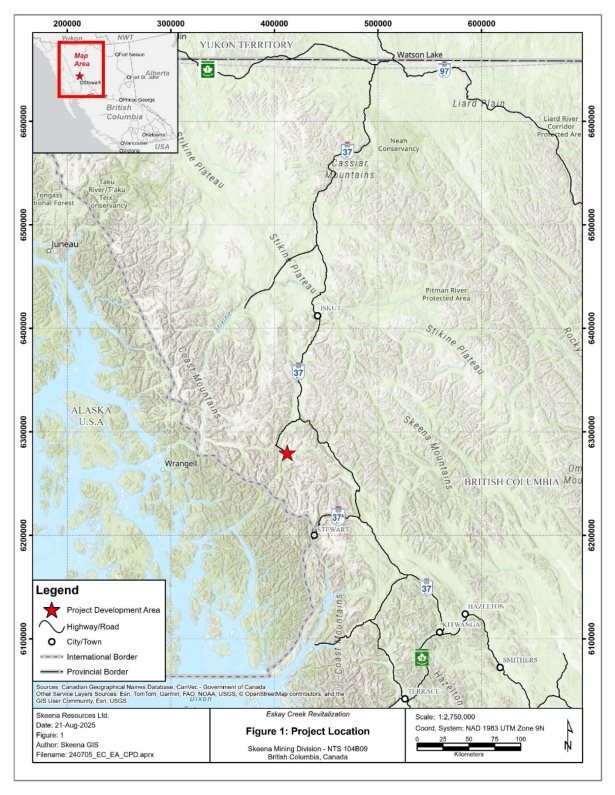
Figure 1 - Text version
Figure 1 is a map of the project location for the Eskay Creek Revitalization Project. It shows a portion of northwest British Colombia with Watson Lake at the northern edge and Terrace at the southern edge. The Project Development Area is highlighted with a star symbol roughly equidistant between Iskut and Stewart. The provincial and international borders are highlighted, as is Highway 37, which connects all the aforementioned towns and the Project Development Area.
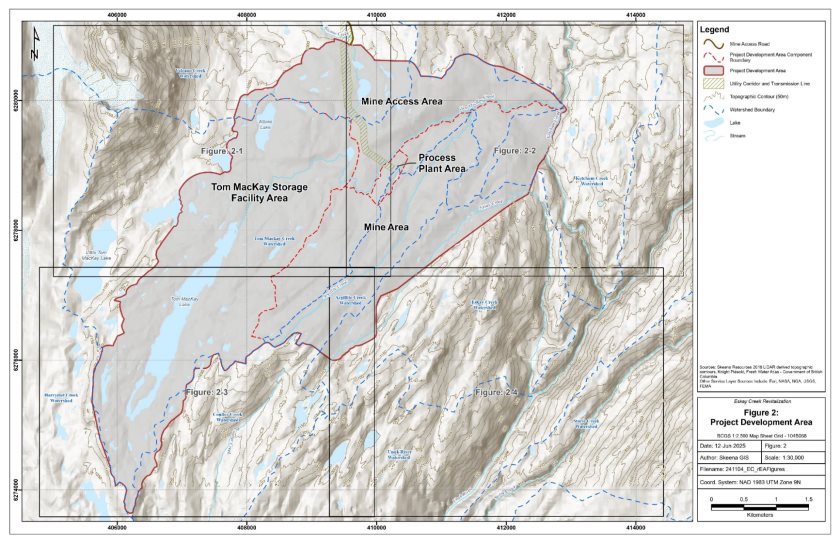
Figure 2 - Text version
Figure 2 is a map showing the Project Development Area (PDA) for the Eskay Creek Revitalization Project. It is broken up into 4 sections. The Tom MacKay Storage Facility Area is the largest, taking up roughly half of the PDA. The Mine Area and Mine Access Area together make up the other half of the PDA, while the Process Plant Area is a much smaller polygon situated in the center of the PDA. On the map, topography, lakes, streams and watershed boundaries are highlighted. The Utility Corridor and Transmission Line are also shown passing through the Mine Access Area into the Process Plant Area.
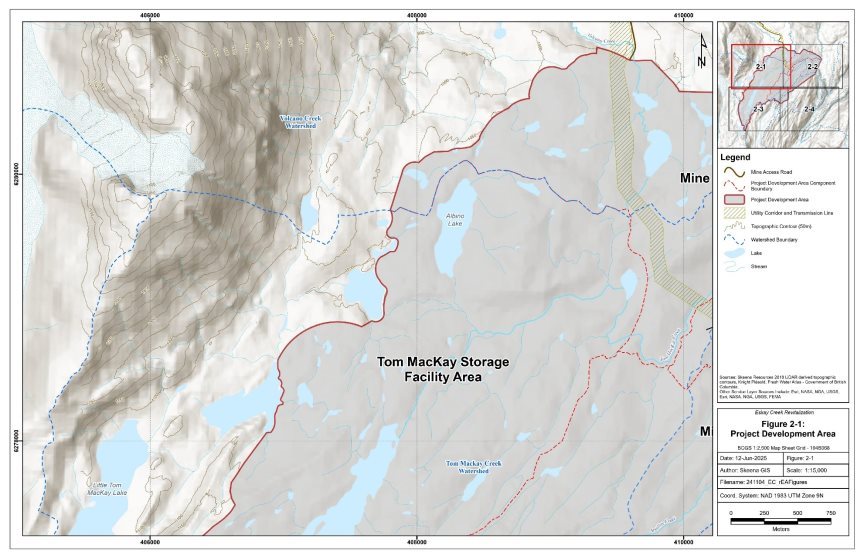
Figure 2-1 - Text version
Figure 2-1 simply shows the top left quadrant of Figure 2, as an opportunity to zoom in on the Project Development Area and allow the viewer to see more detail. No additional details are added to Figure 2-1 than are present in Figure 2.
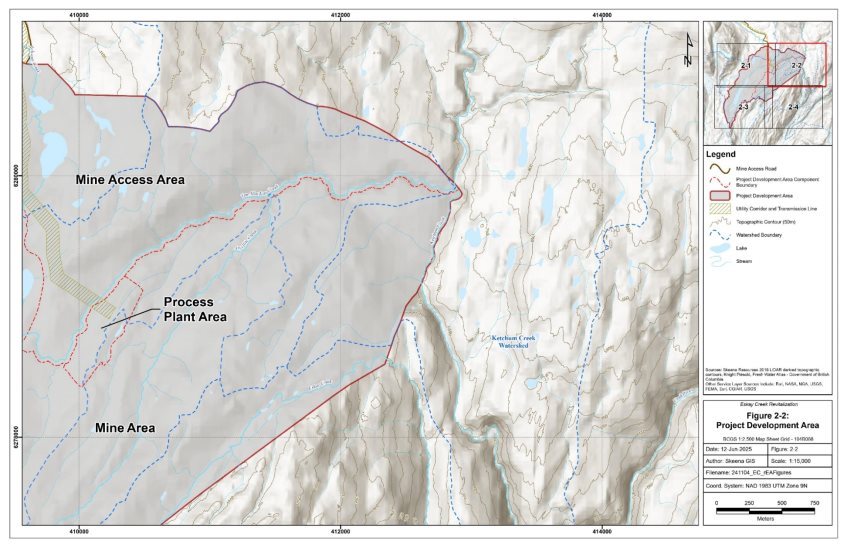
Figure 2-2 - Text version
Figure 2-2 simply shows the top right quadrant of Figure 2, as an opportunity to zoom in on the Project Development Area and allow the viewer to see more detail. No additional details are added to Figure 2-2 than are present in Figure 2.
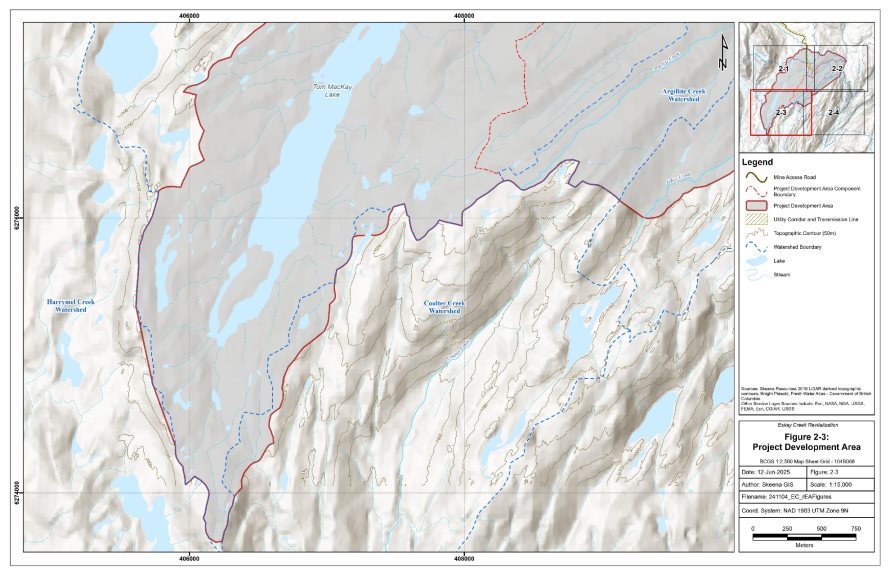
Figure 2-3 - Text version
Figure 2-3 simply shows the bottom left quadrant of Figure 2, as an opportunity to zoom in on the Project Development Area and allow the viewer to see more detail. No additional details are added to Figure 2-3 than are present in Figure 2.
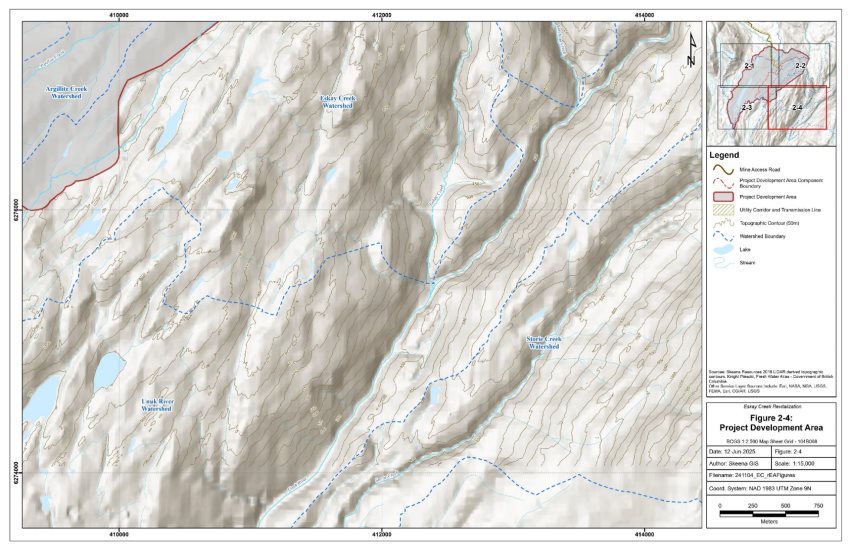
Figure 2-4 - Text version
Figure 2-4 simply shows the bottom right quadrant of Figure 2, as an opportunity to zoom in on the Project Development Area and allow the viewer to see more detail. No additional details are added to Figure 2-4 than are present in Figure 2.
Reasons for Determination
As Minister of the Environment, I have made two determinations pursuant to paragraphs 60(1)(a) and (b) of the Impact Assessment Act, in respect of the impact assessment of the Eskay Creek Revitalization Project open pit gold-silver mine, the Designated Project. I determined, pursuant to paragraph 60(1)(a), that certain adverse effects within federal jurisdiction of the Designated Project, as indicated in the Assessment Report, are likely to be significant to some extent, as outlined in Section 2. Pursuant to paragraph 60(1)(b), I also determined that these effects are justified in the public interest in light of my consideration of the factors referred to in section 63 of the Impact Assessment Act, as outlined in Section 3. Below are the reasons for my determinations.
1. Scope and nature of determinations
My determinations under paragraphs 60(1)(a) and (b) of the Impact Assessment Act in respect of the Designated Project require consideration of the Assessment Report. They also require consideration of:
- whether the adverse effects within federal jurisdiction—and the adverse direct or incidental effectsFootnote 2—indicated in the Assessment Report are likely to be, to some extent, significant and, if so, the extent to which those effects are significant, after taking into account the implementation of any mitigation measures; and
- whether the likely significant adverse effects are justified in the public interest in light of the extent to which they are significant and the factors set out in section 63 of the Impact Assessment Act. The factors are:
- the impact that the likely effects of the Designated Project may have on any Indigenous group and any adverse impact that those effects may have on the rights of the Indigenous peoples of Canada recognized and affirmed by section 35 of the Constitution Act, 1982 (rights of Indigenous Peoples);
- the extent to which the likely effects of the Designated Project contribute to the Government of Canada's ability to meet its environmental obligations and its commitments in respect of climate change; and
- the extent to which the likely effects of the Designated Project contribute to sustainability.
The substituted assessment process included opportunities for meaningful participation of the public on matters of both federal and provincial jurisdictions. The Assessment Report describes how public input was considered, including in key areas such as effects on fish and fish habitat, effects related to transboundary water pollution, effects to Indigenous peoples, and cumulative effects from the Designated Project along with other projects and activities in the region.
I also considered the federal and provincial governments' collaborative approach to and outcomes of consultation with Indigenous groups as integrated into the substituted assessment process, including consultation on draft potential federal conditions.
2. Adverse effects within federal jurisdiction
The Assessment Report describes the effects of the Designated Project and concludes that the Designated Project would result in adverse effects within federal jurisdiction, as defined in the Impact Assessment Act. The Assessment Report also identifies recommended mitigation measures, which I considered appropriate, to eliminate, reduce, control or offset the adverse effects within federal jurisdiction, to the extent possible. British Columbia's (B.C.) recommended mitigation measures and follow-up programs related to adverse effects within federal jurisdiction which are not addressed through provincial mechanisms were included as conditions that I established in Schedule 3 of the Decision Statement.
I have taken into account the Assessment Report and the implementation of mitigation measures in determining the following:
- Fish and fish habitat: The effects are significant to a low to moderate extent. The Designated Project could result in adverse effects to fish and fish habitat caused by changes in water quality affecting plants, invertebrates, and fish through direct toxicity or bioaccumulation of metals, including selenium, in the aquatic food chain; changes in water quality on sediment accumulation of contaminants; and changes in water quantity and flow on aquatic resources and fish habitat. Although the most direct impacts would occur in non-fish-bearing watercourses near the project, contaminants would travel downstream and affect fish-bearing watercourses. The Designated Project is also expected to cause a reduction in water flow in Ketchum Creek below the minimum levels needed to support fish. I recognize that uncertainties remain in predicting future selenium levels without a site-specific model and in-water flow analysis which will be conducted as part of provincial permitting processes. Taking these uncertainties into account, along with the implementation of mitigation measures, including a fish tissue baseline report, water quality and quantity model validation report, requirements of a potential authorization under the Fisheries Act, and the aquatic effects monitoring program required under the provincial Environmental Management Act, I considered the effects to fish and fish habitat to be significant to a low to moderate extent.
- Migratory birds: The effects are not significant. The Designated Project could result in adverse effects to migratory birds caused by direct and indirect loss of wildlife habitat, changes to wildlife movement patterns, and changes in mortality risk caused by land clearing activities, sensory disturbance, and wildlife-vehicle collisions. The Designated Project does not overlap with critical habitat for migratory birds. The Designated Project and other projects that may interact cumulatively are not likely to result in a reduction in the amount or composition of habitats that would threaten the persistence or viability of migratory bird species in the regional area. Cumulative effects to migratory bird mortality and movement are therefore expected to be of low magnitude. Taking into account the implementation of mitigation measures, including pre-construction surveys, setbacks from nesting areas, and compensation of barn swallow nesting sites, I considered the effects to migratory birds to be not significant.
- Transboundary water pollution: The effects are not significant. The Designated Project could result in adverse effects to water quality in the Unuk River at the British Columbia-Alaska border caused by changes in metal concentrations. Contaminants of potential concern that would increase in concentration in the Unuk River, when effects of the project are considered cumulatively with other development in the area, include nickel, zinc, thallium, and selenium. However, modelling results indicated that only thallium may result in an exceedance of relevant water quality guidelines at the border. When modelling between baseline and project-influenced scenarios was compared (i.e., with and without the Designated Project), thallium exceedances did not show a meaningful difference between the two scenarios. Thallium concentrations are naturally elevated in the area, and the modelled exceedance was explained to be driven primarily by high total suspended sediment in glacial melt waters. Furthermore, it was determined that increases in thallium would have negligible effects on fish and fish habitat because modelled concentrations in the Unuk River did not exceed the relevant water quality guideline thresholds developed to be protective of fish and fish habitat. While selenium did not exceed water quality guidelines at the border, it was identified as a key concern of the Technical Advisory Committee, Indigenous groups, and the public. Taking into account the implementation of mitigation measures, including a water quality and quantity model validation report, and the aquatic effects monitoring program with selenium monitoring requirements required under the provincial Environmental Management Act, I considered the effects on transboundary water pollution to be not significant.
- Effects on Indigenous peoples are predicted to occur within Construction, Operations, Reclamation and Closure phases, including:
- Physical and cultural heritage for Indigenous peoples: The effects are significant to a low extent. The Designated Project could result in adverse effects from construction activities, operational processes, and workforce participation. These could include disrupted or restricted access to sacred and culturally important sites and landscape, and effects such as noise or changes to the visual environment. Taking into account the implementation of mitigation measures, such as prohibiting employees and contractors from fishing, hunting, trapping, plant gathering, using off-road vehicles for recreation purposes and from accessing the areas surrounding the Project site unless exercising Aboriginal rights, I considered these effects to be significant to a low extent.
- Current use of lands and resources for traditional purposes by Indigenous peoples: The effects are significant to a low extent. The Designated Project could result in adverse effects to the availability and condition of lands and resources, and reduced opportunities for engaging in current use activities caused by construction and operational activities such as land and vegetation clearing, increased human presence, and resultant changes to wildlife populations and movement patterns. It is important to note the potential for limited access to areas traditionally used for hunting, trapping, fishing, and gathering plants, and other cultural practices, in which changes could influence the availability or quality of country foods and culturally significant plant species. Taking into account the implementation of mitigation measures such as those related to mitigating impacts to ungulates and bears from Designated Project-related vehicle traffic, those related to mitigating fugitive dust emissions attributable to the Designated Project, and the implementation of progressive reclamation, as meaningful approaches to address concerns and to support culturally informed strategies, I considered these effects to be significant to a low extent.
- Any structure, site or thing that is of historical, archeological, paleontological or architectural significance to Indigenous peoples: The effects are not significant. While the possibility remains for the Designated Project to result in adverse effects to unidentified archaeological, paleontological, or architectural resources from construction activities, taking into account the footprint of the existing Designated Project, the lack of identified archaeological, paleontological, or architectural resources in the project development area, and the implementation of mitigation measures, such as the development and implementation of a chance find protocol, I considered these effects to be not significant.
- The health, social or economic conditions of Indigenous peoples: The direct effects are significant to a low extent, while the effects are significant to a low to moderate extent when considered cumulatively with the effects of other projects and activities in the region. The Designated Project could adversely affect the safety and security of Indigenous women, girls, and gender-diverse people through population growth, increased transportation activity, the influx of a transient workforce, and possible increased demand on local safety and health services. With these potential effects in mind, it is important to consider the EAO's conclusion on the Designated Project's contributions to a broader regional pattern of environmental, social, and health-related changes, with particular consideration of the Final Report of the National Inquiry into Missing and Murdered Indigenous Women and Girls and its Calls for Justice—especially those recommendations that address health, justice, and wellness. The Designated Project is expected to deliver meaningful socio-economic benefits through employment and training opportunities, increased earnings, and associated economic gains, though these may be unevenly distributed across different groups and individuals. I acknowledge that women, Elders, children, and other subgroups may be disproportionately affected by adverse social and cultural impacts of the Designated Project, such as population growth. Taking into account the implementation of mitigation measures, such as workplace policies that promote safe, respectful, and inclusive conduct, including training on harassment prevention, violence awareness, and cultural sensitivity, I considered these direct effects to be significant to a low extent, and when considered cumulatively with the effects of other projects and activities in the region, I consider these effects to be significant to a low to moderate extent.
The Designated Project is not expected to cause adverse changes to the environment that would occur on federal lands. I considered these effects to be negligible, so they are not included in the definition of adverse effects within federal jurisdiction.
The mitigation measures identified in the Assessment Report include requirements to avoid or lessen potential effects on terrestrial wildlife species listed on Schedule 1 of the Species at Risk Act. The measures relate to adverse effects during all phases of the Designated Project. I considered the measures to be consistent with applicable strategies and action plans, and to fulfill my obligations under section 79 of the Species at Risk Act. I am satisfied that potential effects to species at risk and their critical habitat can be addressed, to the extent practical, through the identified provincial mechanisms.
I have determined, with the implementation of mitigation measures, the extent of significance of adverse effects within federal jurisdiction is predicted to range from not significant to significant to a low to moderate extent as set out above. Significant adverse effects within federal jurisdiction remain likely after the consideration of mitigation measures; therefore, as part of my determinations, I also considered the factors in section 63 of the Impact Assessment Act in determining whether these effects are justified in the public interest.
3. Public interest factors
3.1 Impacts of the Likely Effects of the Designated Project on Indigenous Groups and the Adverse Impacts that those Effects May Have on the Rights of Indigenous peoples
In considering whether the Designated Project's significant adverse effects within federal jurisdiction are justified in the public interest, I considered the likely effects on Indigenous groups and the likely adverse impacts on the rights of Indigenous peoples as summarized below.
For this Designated Project, the Crown, through the Impact Assessment Agency of Canada (IAAC) and relying on B.C. in the substituted assessment, carried out collaborative consultation with Tahltan Nation, Nisg̱a'a Nation, Tsetsaut / Skii km Lax Ha, Gitanyow Nation, and Métis Nation British Columbia.
In considering this factor, I took into account Indigenous Knowledge provided in the Assessment Report, including assessments led by Indigenous groups, which informed the assessment of effects to valued components and impacts on the rights of Indigenous peoples.
The Designated Project would be located on and adjacent to the existing Eskay Creek Mine, approximately 83 kilometers northwest of Stewart, B.C. In accordance with paragraph 8(e) of Chapter 10 of the Nisga'a Final Agreement (Nisg̱a'a Treaty), this includes Nisg̱a'a Lands and Nisg̱a'a Treaty interests, including those related to cultural and family wellbeing under federal, provincial, and Nisg̱a'a Nation jurisdictions. Chapter 10 of the Nisg̱a'a Treaty required the consideration of whether the project can reasonably be expected to have adverse environmental effects on residents of Nisg̱a'a Lands, or Nisg̱a'a interests, and of the effects of the project on the existing and future economic, social, and cultural wellbeing of Nisg̱a'a citizens. The Chapter 10 assessment under the Nisga'a Treaty specifically considered the transportation routes along Highway 37 to the Nass Area, along Highway 37 within the Nass Area and Nass Wildlife Area, and Highway 37A to port facilities in Stewart, B.C. to the point at which concentrate is loaded onto vessels at the port facilities, which are included as part of the Designated Project, as well as the planned use of vessels carrying concentrate in and around the Port of Stewart, which is not part of the Designated Project. Nisga'a Lisims Government conducted an assessment under Chapter 10 of the Nisga'a Treaty in the Assessment Report and concluded that the project should proceed.
The Tahltan Central Government conducted a Tahltan Risk Assessment and issued a Notice of Decision for approval in accordance with the Declaration Act Consent Decision-Making Agreement between the Province of B.C. and the Tahltan Central Government (the Consent Agreement). The Tahltan Central Government also issued a Notice of Consent under B.C.'s participating Indigenous nation framework.
I recognize that the Designated Project would benefit some Indigenous groups and have adverse impacts on the same, or other Indigenous groups. Adverse impacts that the Designated Project would have on the rights of Indigenous peoples include impacts to current use of lands and resources, such as reductions in the quantity and quality of available resources, access to traditional lands, and ability to continue traditional practices. Indigenous cultural heritage may also be affected, including both physical cultural assets and the transmission of cultural knowledge and traditions. Additionally, the Designated Project may influence the health, social, and economic conditions of Indigenous peoples, with potential effects to physical and mental health, and implications to infrastructure and services that support community well-being. These impacts can be addressed, in part, through the legally binding conditions I established in Schedule 3 of the Decision Statement, and through the provincial mechanisms.
I understand that Indigenous groups have raised concerns regarding potential effects of the Designated Project, including impacts on water quality and associated water treatment needs, fish and fish habitat, and the risk of accidents and malfunctions. Timelines for water treatment, particularly in relation to the Tahltan Sustainability Criteria, were identified by Tahltan Nation as a specific concern. These issues are acknowledged by Tahltan Nation as being addressed, in part, through the processes and mechanisms established under the Consent Agreement. Further concerns have been raised regarding cumulative effects occurring beyond the scope of the Designated Project, particularly in the Portland Canal and Port of Stewart area. These are related to potential impacts in the marine environment from marine vessel traffic and port operations though do not factor into my impact assessment determinations under the Impact Assessment Act as they are not part of the Designated Project. In consideration of these, mitigation measures, such as a Traffic Corridor Management Plan which includes measures to minimize concentrate dust and requires the use of sealed containers and/or sealed truck covers when transporting concentrate from the mine site to the Port of Stewart, and existing federal and provincial regulatory and non-regulatory initiatives, have also been taken into account to address risks and support environmental protection.
The Government of Canada continues to advance initiatives aligned with the Calls for Justice from the Final Report on Missing and Murdered Indigenous Women and Girls in acknowledgement of the wider cumulative impacts that may disproportionately affect Indigenous peoples, particularly women, girls, and gender-diverse individuals. These initiatives include the Pathway to Safe Indigenous Communities Program, the Gender-Based Violence Strategy, the National Action Plan to End Gender-Based Violence, and actions under Shared Priority Measure 12 of the United Nations Declaration Act Action Plan. These efforts are further supported by the legislative requirement to conduct Gender-Based Analysis Plus as part of the impact assessment process. These programs, strategies, and legislative measures aim to strengthen safety and well-being in Indigenous communities, while supporting a holistic approach to community health—particularly for Indigenous women, girls, and gender-diverse individuals.
I understand that at the conclusion of the assessment, taking into consideration the potential conditions, Indigenous groups provided letters of consent or lack of consent to the provincial Ministers. I acknowledge that the Tahltan Nation has provided consent for the Project and Nisga'a Nation has provided a notice of consent for the Project, while Tsetsaut / Skii km Lax Ha, Gitanyow Nation, and Métis Nation British Columbia have not currently provided a notice of consent or lack of consent to B.C.
As outlined above, and as documented in the Assessment Report, including Section 6, Appendix 5, and Appendix 13, and demonstrated through the consultation record for the Designated Project, I am of the view that federal consultation obligations have been met in a manner consistent with the principle of the Honour of the Crown. Indigenous groups potentially impacted by the Designated Project were consulted in order to fully understand their concerns and the nature and severity of potential impacts on Aboriginal and treaty rights. In addition, non-resident Indigenous peoples were engaged with the intention of fully understanding the project's potential impacts on them and addressing their concerns. I am satisfied that implementation of federal and provincial conditions will appropriately avoid or minimize potential impacts of the Designated Project on Aboriginal and treaty rights.
3.2 Extent to Which the Likely Effects of the Designated Project Contribute to the Government of Canada's Ability to Meet Its Environmental Obligations and Its Commitments in Respect of Climate Change
In considering whether the adverse effects within federal jurisdiction are justified in the public interest, I considered the extent to which the likely effects of the Designated Project contribute to the Government of Canada's ability to meet its environmental obligations and its commitments in respect of climate change. I determined that the likely effects of the Designated Project would not contribute to the Government of Canada's ability to meet its environmental obligations and commitments in respect of climate change, and, therefore, this public interest factor did not weigh in to my determination of whether the Designated Project's adverse effects within federal jurisdiction are justified in the public interest.
With regard to environmental obligations, I considered the adverse effects of the Designated Project on terrestrial environments and species at risk. Some of the effects, particularly effects on species at risk, may not be fully mitigated. As such, I determined that the Designated Project would not contribute to Canada's ability to meet its environmental obligations under the Convention on Biological Diversity; the Species at Risk Act and associated recovery strategies and action plans for listed species; the Convention for the Protection of Migratory Birds in the United States and Canada as implemented through the Migratory Birds Convention Act, 1994; and Article IV of the Boundary Waters Treaty.
For commitments in respect of climate change, I considered the Strategic Assessment of Climate Change carried out for the Designated Project and advice provided by Environment and Climate Change Canada. The Assessment Report sets out that the Designated Project would not contribute to Canada's ability to meet its shorter-term commitments in respect of climate change, including those within Canada's 2030 Emissions Reduction Plan. However, the Designated Project would align with Canada's longer-term commitments, including those outlined in the Canadian Net Zero Emissions Accountability Act, with the implementation of the proponent's plan to achieve net-zero by 2050.
Given the above, this public interest factor did not weigh in to my determination on whether the Designated Project's adverse effects within federal jurisdiction are justified in the public interest.
3.3 Extent to Which the Likely Effects of the Designated Project Contribute to Sustainability
I considered the extent to which the Designated Project's likely effects contribute to sustainability in determining whether the Designated Project's adverse effects within federal jurisdiction are justified in the public interest.
The Assessment Report provides a holistic understanding of the adverse effects within federal jurisdiction and positive effects likely to be caused by the Designated Project, the interactions between these effects, and their long-term consequences. I took into account how the Designated Project may affect the ability of communities today, and in the future, to provide for their health, social, economic and cultural well-being, and the extent to which ecosystem integrity would be maintained if the Designated Project were to proceed. In particular, I considered issues of importance to Indigenous groups and the following key considerations:
- Positive effects for current and future generations through socio-economic benefits—such as job creation, income growth, and skill development— that can support economic growth and reinforce traditional economies for Indigenous and local communities. Infrastructure upgrades, including improved roadway corridors, may further boost economic resilience and community well-being. These benefits may also strengthen financial independence and improve access to essential services for both current and future generations, although I acknowledge that the extent of these positive impacts may vary among community members, with some individuals and groups experiencing greater advantages than others.
- Positive contributions to Indigenous self-governance and self-determination that may arise from the outcomes of the Designated Project, including Nations' meaningful participation in decision-making processes that respects and upholds cultural values and priorities. This extends beyond economic development and may contribute to broader reconciliation efforts by affirming Indigenous peoples' autonomy, leadership, and governance.
I determined that the Designated Project's likely effects would have net positive contributions to sustainability for present and future generations, taking into account measures to increase positive effects and to mitigate adverse effects within federal jurisdiction. Implementation of follow-up and monitoring programs that I established in the conditions in Schedule 3 of the Decision Statement, along with provincial mechanisms described in the Assessment Report, will enable adverse effects to be adaptively managed.
4. Additional considerations from the assessment report
An assessment of the effects of accidents and malfunctions is required under section 22 of the Impact Assessment Act and is included in the Assessment Report. Key accidents and malfunctions identified in the assessment included accidental discharge of mine-influenced water from failure of the water treatment system, tailings dam, or other containment structures; motor vehicle accidents; and accidents affecting health or safety. Accidents and malfunctions could result in impacts to fish and fish habitat, Indigenous peoples' health, social, and economic conditions, and transboundary water pollution. These accidents and malfunctions, and their effects, were identified as key issues by the Technical Advisory Committee, Indigenous groups, and the public. Impacts on local emergency and health services were also raised as a key issue. Measures to prevent or otherwise address these concerns were identified in the Assessment Report and have been included as conditions that I established in Schedule 3 of the Decision Statement or identified provincial mechanisms, where appropriate.
The Assessment Report also recommended follow up programs, as required under section 22 of the Impact Assessment Act, to verify the accuracy of the assessment and determine the effectiveness of mitigation measures, which included requirements related to key components of the environment. Where appropriate, follow-up programs related to adverse effects in federal jurisdiction are included as conditions that I established in Schedule 3 of the Decision Statement.
In addition, the seven potentially impacted Alaskan Tribes, as represented by the Southeast Alaska Indigenous Transboundary Commission (SEITC) participated in the substituted assessment process to support the Crown's understanding of the project's potential impacts on Alaskan Tribes, and ensure their concerns were addressed.
5. Conclusion
I am satisfied that the Assessment Report has considered the likely effects of the Designated Project and the adverse effects within federal jurisdiction, including those effects on Indigenous groups. I considered the recommended mitigation measures proposed in the Assessment Report to eliminate, reduce, control or offset the adverse effects within federal jurisdiction to be appropriate. Further, the substituted assessment process incorporated reliance on provincial mechanisms, such as conditions, permits, and authorizations, to address certain federal effects. The intent of this is to reduce duplicative conditions and streamline regulatory requirements for IAAC, the EAO, the proponent, and the parties that would be consulted. Section 64(4)(a) of the IAA requires that I establish any conditions that I consider appropriate in relation to the adverse effects within federal jurisdiction that are indicated in the Assessment Report, other than those the implementation of which I am satisfied will be ensured by another jurisdiction. In the cases where no provincial mechanism exists to implement the mitigation measures, I have established legally binding federal conditions, with which the proponent must comply, in Schedule 3 of the Decision Statement.
I have determined that, with the implementation of mitigation measures:
- adverse effects on fish and fish habitat would be significant to a low to moderate extent;
- adverse effects on physical and cultural heritage would be significant to a low extent;
- adverse effects on the current use of lands and resources for traditional purposes by Indigenous peoples would be significant to a low extent;
- adverse effects on any structure, site or thing of historical, archaeological, paleontological or architectural significance would be not significant; and
- adverse effects on the health, social or economic conditions of Indigenous peoples would be significant to a low extent, while the adverse effects would be significant to a low to moderate extent when considered cumulatively with the effects of other projects and activities.
I also determined that these adverse effects within federal jurisdiction are justified in the public interest given that the extents of significance range from not significant to significant to a low to moderate extent, and the Designated Project represents an important opportunity to promote economic reconciliation with Indigenous peoples and communities by supporting self-governance and self-determination. Its anticipated outcomes would contribute to sustainability by generating positive economic impacts, and enhancing community well-being in the region.
Conditions Established under Section 64 of the Impact Assessment Act
1. Definitions
1.1 Adverse federal effects means "adverse effects within federal jurisdiction" and "direct or incidental adverse effects" as defined in section 2 of the Impact Assessment Act.
1.2 Agency means the Impact Assessment Agency of Canada.
1.3 Application means the Revised Environmental Assessment Certificate Application submitted to the British Columbia Environmental Assessment Office on March 31, 2025, entitled Eskay Creek Revitalization Project: Revised Application for an Environmental Assessment Certificate / Impact Statement and any supplementary information filed by the Proponent for the purposes of completing the assessment.
1.4 Assessment Report means the report prepared by the British Columbia Environmental Assessment Office pursuant to subsection 33(1) of the Impact Assessment Act.
1.5 Baseline means the environmental, health, social and economic conditions prior to initiating construction of the Designated Project.
1.6 Construction means the phase of the Designated Project during which the Proponent undertakes the site preparation, building or installation of any components of the Designated Project, including periods during which these activities may temporarily cease.
1.7 Contact water means water that has come into contact with Designated Project mine workings or surface infrastructure, including mine rock and tailings and terrain where Designated Project infrastructure components are built and where mining activities are occurring, but excluding diversion structures.
1.8 Days means calendar days.
1.9 Decommissioning means the phase of the Designated Project during which the Proponent permanently ceases commercial production and commences removal from service of any components of the Designated Project, and that continues until the Proponent completes the final reclamation of the Designated Project area, with the exception of the water treatment plant(s) and associated ancillary infrastructure which will remain operational during the post-closure phase.
1.10 Designated Project means the Eskay Creek Revitalization Project described in Schedule 1 of this Decision Statement.
1.11 Designated Project area means the Project Development area described in Figure 2 and Figures 2-1 to 2-4 of Schedule 1 of this Decision Statement.
1.12 Environment and Climate Change Canada means the Department of the Environment as established under subsection 2(1) of the Department of the Environment Act.
1.13 Fish means "fish" as defined in subsection 2(1) of the Fisheries Act.
1.14 Fish habitat means "fish habitat" as defined in subsection 2(1) of the Fisheries Act.
1.15 Fisheries and Oceans Canada means the Department of Fisheries and Oceans as established under subsection 2(1) of the Department of Fisheries and Oceans Act.
1.16 Follow-up program means "follow-up program" as defined in section 2 of the Impact Assessment Act.
1.17 Health Canada means the Department of Health as established under subsection 2(1) of the Department of Health Act.
1.18 Impact assessment means "impact assessment" as defined in section 2 of the Impact Assessment Act.
1.19 Indigenous groups means the following Indigenous peoples: Gitanyow Nation, Métis Nation British Colombia, Nisga'a Nation, Tahltan Nation, and Tsetsaut/Skii km Lax Ha.
1.20 Indigenous peoples means "Indigenous peoples of Canada" as defined in section 2 of the Impact Assessment Act.
1.21 Migratory bird means "migratory bird" as defined in subsection 2(1) of the Migratory Birds Convention Act, 1994.
1.22 Mitigation measures means "mitigation measures" as defined in section 2 of the Impact Assessment Act.
1.23 Monitoring means collecting, analyzing, and using information to measure the adverse federal effects of the Designated Project and/or to verify the accuracy of the impact assessment and/or to determine the effectiveness of any mitigation measure.
1.24 Operation means the phase of the Designated Project starting when commercial production takes place and continuing until decommissioning begins. This phase includes periods during which commercial production may temporarily cease.
1.25 Post-closure means the phase of the Designated Project that begins when decommissioning is complete and ends when active water treatment is completed and all end points for follow-up programs established pursuant to condition 2.4.7 have been met.
1.26 Proponent means Eskay Creek Mining Limited and its successors or assigns.
1.27 Qualified individual means someone who, through education, experience and knowledge relevant to a particular matter, provides the Proponent with advice within their area of expertise. Knowledge relevant to a particular matter may include community and Indigenous knowledge.
1.28 Record means "record" as defined in section 2 of the Impact Assessment Act.
1.29 Relevant authority means federal, provincial and/or municipal authorities that are in possession of specialist or expert information or knowledge, or that have a responsibility for the administration of a law or regulation, with respect to the subject matter of a condition set out in this Decision Statement.
1.30 Reporting year means January 1 to December 31 of the same calendar year.
1.31 Substantially begin means initiating the following components and activities required to carry out the Designated Project:
- 1.31.1 construction of the processing plant; and
- 1.31.2 construction of the Mine Water Treatment Plant Stage 2.
1.32 Sustainability means "sustainability" as defined in section 2 of the Impact Assessment Act.
2. General and administrative conditions
2.1 The Proponent shall ensure that its actions in meeting the conditions set out in this Decision Statement during all phases of the Designated Project are considered in a careful and precautionary manner, are informed by the best information and knowledge available at the time the Proponent takes action, including the most recent version of policies, guidelines and directives and community and Indigenous knowledge, are based on methods and models that are recognized by standard-setting bodies, are undertaken by qualified individuals, and have applied the best available economically or technically feasible technologies, or both.
Consultation
2.2 The Proponent shall, where consultation is a requirement of a condition set out in this Decision Statement:
- 2.2.1 provide a written notice of the opportunity for the parties being consulted to present their views and information on the subject matter of the consultation;
- 2.2.2 provide all available information that is relevant to the scope and the subject matter of the consultation and a reasonable period of time not less than 30 days, or as otherwise agreed upon with the parties being consulted, to prepare their views and information;
- 2.2.3 undertake an impartial consideration of all views and information presented by the parties being consulted on the subject matter of the consultation; and
- 2.2.4 advise as soon as feasible in writing the parties being consulted on how the views and information received have, or have not, been integrated into the subject matter of the consultation by the Proponent and provide a justification.
2.3 The Proponent shall, where consultation with Indigenous groups is a requirement of a condition set out in this Decision Statement, seek mutual agreement with each Indigenous group with respect to the manner to satisfy the consultation requirements referred to in condition 2.2, including:
- 2.3.1 methods of notification;
- 2.3.2 the type of information and the period of time to be provided when seeking input;
- 2.3.3 the process to be used by the Proponent to undertake impartial consideration of all views and information presented on the subject of the consultation; and
- 2.3.4 the period of time and the means to advise Indigenous groups of how their views and information were considered by the Proponent.
Follow-up requirements
2.4 The Proponent shall, where a follow-up program is a requirement of a condition set out in this Decision Statement, develop the follow-up program taking into account any guidance documents provided by the Agency and determine, as part of the development of each follow-up program and in consultation with the parties being consulted during the development, the following information, unless already specified in the condition:
- 2.4.1 a description of the effects predictions or mitigation measures or both that will be evaluated through the follow-up program as required in the particular follow-up program condition;
- 2.4.2 the methodology, location, frequency, timing and duration of monitoring associated with the follow-up program;
- 2.4.3 the scope, content and frequency of reporting of the results of the follow-up program to the parties consulted for the development of the follow-up program;
- 2.4.4 the minimum frequency at which the follow-up program must be reviewed and, if necessary, updated;
- 2.4.5 the levels of environmental change relative to baseline that would require the Proponent to implement modified or additional mitigation measure(s), including instances where the Proponent may require Designated Project activities causing the environmental change to be stopped;
- 2.4.6 the technically and economically feasible mitigation measures to be implemented by the Proponent if monitoring conducted as part of the follow-up program shows that the levels of change referred to in condition 2.4.5 have been reached or exceeded in order to return changes to levels below those referred to in condition 2.4.5; and
- 2.4.7 the specific quantifiable end points that must be achieved before the follow-up program can end. Those end points should indicate that the accuracy of the impact assessment has been verified or that the mitigation measures are effective or both.
2.5 The Proponent shall update the details for each follow-up program pursuant to condition 2.4 during the implementation of each follow-up program, at the minimum frequency determined pursuant to condition 2.4.4 and in consultation with the parties being consulted during the development of each follow-up program.
2.6 The Proponent shall provide the information determined for each of the follow-up programs referred to in conditions 3.3, 3.4, 3.5 and 6.1, including the information determined for each follow-up program pursuant to condition 2.4, to the Agency and to the parties being consulted during the development of each follow-up program prior to the implementation of each follow-up program. The Proponent shall also provide any update made pursuant to condition 2.5 to the Agency and to the parties being consulted during the development of each follow-up program within 30 days of the follow-up program being updated.
2.7 The Proponent shall, where a follow-up program is a requirement of a condition set out in this Decision Statement:
- 2.7.1 implement the follow-up program according to the information determined pursuant to condition 2.4 and any requirement specified in conditions specific to each follow-up program;
- 2.7.2 conduct monitoring and analysis to verify the accuracy of the impact assessment predictions as it pertains to the particular condition or to determine the effectiveness of any mitigation measure or both;
- 2.7.3 determine whether modified or additional mitigation measure(s) are required based on the monitoring and analysis undertaken pursuant to condition 2.7.2;
- 2.7.4 if modified or additional mitigation measure(s) are required pursuant to condition 2.7.3, develop and implement these mitigation measure(s) as soon as feasible and monitor them pursuant to condition 2.7.2. The Proponent shall notify the Agency in writing within 24 hours of any modified or additional mitigation measure being implemented. If the Proponent implements any additional or modified mitigation measure not previously submitted to the Agency pursuant to condition 2.6, the Proponent shall submit a detailed description of the measure(s) to the Agency within 7 days of their implementation; and
- 2.7.5 report all results of the follow-up program, including whether assessment predictions are accurate or mitigation measures are effective, or both as required in the follow-up program condition, to the Agency no later than 3 months following each reporting year during which the follow-up program is implemented and, subject to information determined pursuant to 2.4.3, to the parties being consulted during the development of the follow-up program.
2.8 Where consultation with Indigenous groups is a requirement of a follow-up program, the Proponent shall discuss the follow-up program with each group and shall determine, in consultation with each group, opportunities for participation and resources required to support their participation in the implementation of the follow-up program, including the conduct of monitoring, the analysis and reporting of follow-up results and whether modified or additional mitigation measure(s) are required, as set out in condition 2.7.
Annual reporting
2.9 The Proponent shall prepare an annual report for each reporting year that sets out:
- 2.9.1 the activities undertaken by the Proponent to comply with each of the conditions set out in this Decision Statement;
- 2.9.2 how the Proponent complied with condition 2.1;
- 2.9.3 for conditions set out in this Decision Statement for which consultation is a requirement, how the Proponent considered any views and information that the Proponent received during or as a result of the consultation, including any Indigenous knowledge;
- 2.9.4 the information referred to in conditions 2.4 for each follow-up program and any update to that information made pursuant to condition 2.5;
- 2.9.5 a summary of the information reported pursuant to condition 2.7.5 for each follow-up program;
- 2.9.6 for any condition where implementation is stated to be dependent in whole or in part upon technical and/or economic feasibility, and the Proponent has determined it is not technically and/or economically feasible, a justification for that determination;
- 2.9.7 for any plan that is a requirement of a condition set out in this Decision Statement, any update(s) to the plan that have been made during the reporting year; and
- 2.9.8 any modified or additional mitigation measure implemented or proposed to be implemented by the Proponent, as determined pursuant to condition 2.7.
2.10 The Proponent shall submit the annual report referred to in condition 2.9 to the Agency, including a plain language executive summary in both official languages, no later than 3 months following the reporting year to which the annual report applies.
2.11 The first reporting year for which the Proponent shall prepare an annual report pursuant to condition 2.9 shall start on the day the Minister of the Environment issues the Decision Statement pursuant to section 65(1) of the Impact Assessment Act.
Information sharing
2.12 The Proponent shall publish on the Internet, or any medium which is publicly available, the annual reports and the executive summaries referred to in conditions 2.9 and 2.10 the plan referred to in condition 7.2, the protocol referred to in condition 5.1, the schedules referred to in conditions 2.17 and 2.18, and any update or revision to the above documents, upon submission of these documents to the parties consulted for the respective conditions. The Proponent shall keep these documents publicly available for 25 years following the end of operation, or until the end of decommissioning of the Designated Project, whichever comes first. The Proponent shall notify the Agency and Indigenous groups of the availability of these documents within 3 business days of their publication.
2.13 When the development of any plan is a requirement of a condition set out in this Decision Statement, the Proponent shall submit the plan to the Agency prior to implementation unless otherwise required through the condition.
Change of Proponent
2.14 The Proponent shall notify the Agency and Indigenous groups in writing no later than 30 days after the day on which there is any transfer of ownership, care, control or management of the Designated Project in whole or in part.
Change to the Designated Project
2.15 If the Proponent is proposing to carry out the Designated Project in a manner other than described in Schedule 1 of this Decision Statement, the Proponent shall notify the Agency in writing in advance of carrying out the proposed activities. As part of the notification, the Proponent shall provide:
- 2.15.1 a description of the proposed change(s) to the Designated Project and the adverse federal effects that may result from the proposed change(s);
- 2.15.2 any modified or additional measure to mitigate any adverse federal effects that may result from the proposed change(s) and any modified or additional follow-up requirement;
- 2.15.3 an explanation of how, taking into account any modified or additional mitigation measure referred to in condition 2.15.2, the adverse federal effects that may result from the proposed change(s) may differ from the federal effects of the Designated Project identified during the impact assessment; and
- 2.15.4 the results of consultation with Indigenous groups on the proposed changes, if the proposed changes may adversely affect those Indigenous groups.
2.16 The Proponent shall provide to the Agency any additional information required by the Agency about the proposed change(s) referred to in condition 2.15, which may include the results of consultation with relevant authorities on the proposed change(s) and federal effects referred to in condition 2.15.1 and the modified or additional mitigation measures and follow-up requirements referred to in condition 2.15.2.
Schedules
2.17 The Proponent shall submit to the Agency and Indigenous groups a schedule for all conditions set out in this Decision Statement no later than 30 days prior to the start of construction. This schedule shall detail all activities planned to fulfill each condition set out in this Decision Statement and the commencement and estimated completion month(s) and year(s) for each of these activities.
2.18 The Proponent shall submit to the Agency and Indigenous groups a schedule outlining all activities required to carry out all phases of the Designated Project no later than 30 days prior to the start of construction. The schedule shall indicate the commencement and estimated completion month(s) and year(s) and duration of each of these activities.
2.19 The Proponent shall submit to the Agency and Indigenous groups in writing an update to schedules referred to in conditions 2.17 and 2.18 every year no later than 3 months after each reporting year, until completion of all activities referred to in each schedule.
Record keeping
2.20 The Proponent shall maintain all records relevant to the implementation of the conditions set out in this Decision Statement. The Proponent shall retain the records and make them available to the Agency throughout construction and operation and for 25 years following the end of operation or until the end of decommissioning of the Designated Project, whichever comes first. The Proponent shall provide the aforementioned records to the Agency upon demand within a timeframe specified by the Agency.
2.21 The Proponent shall retain all records referred to in condition 2.20 at a facility in Canada and shall provide the address of the facility to the Agency. The Proponent shall notify the Agency at least 30 days prior to any change to the physical location of the facility where the records are retained and shall provide the address of the new location to the Agency.
2.22 The Proponent shall notify the Agency of any change to the contact information of the Proponent included in this Decision Statement as soon as feasible.
3. Fish and fish habitat
3.1 The Proponent shall manage mine effluent before it is deposited into the receiving environments in a manner that is protective of fish and fish habitat. In doing so, the Proponent shall identify and implement measures during all phases, to minimize acid generation and metal leaching within the Designated project area, including from mine waste, stockpiled ore, mine water treatment plant sludge, exposed pit walls and pit benches, and to limit seepage from the Tom MacKay Storage Facility, Mine Rock Storage Area, ore stockpiles, South pit and North pit. The Proponent shall provide these measures to the Agency and Environment and Climate Change Canada prior to their implementation.
3.2 The Proponent shall manage contact water to mitigate effects on fish and fish habitat. In doing so, the Proponent shall:
- 3.2.1 collect contact water including seepage from the Designated Project area during all phases of the Designated Project and treat it, as necessary to meet the predictions of the impact assessment, prior to release into the receiving environment. In doing so, the Proponent shall keep water quality aligned with the predictions identified in Chapter 15 of the Application;
- 3.2.2 identify, prior to construction and in consultation with Environment and Climate Change Canada, Indigenous groups and other relevant authorities, technically and economically feasible measures and their implementation timing to manage contact water from the Tom MacKay Storage Facility and North Pit. The Proponent shall provide these measures to the Agency prior to construction and implement them according to the timing identified. In doing so, the Proponent shall give preference to identifying and implementing source control measures during construction and operation, including source control measures identified in Technical Memo 148 of the Application;
- 3.2.3 review the measures identified pursuant to condition 3.2.2 prior to operation and at a frequency thereafter determined in consultation with the parties consulted in condition 3.2.2 and update the measures, as necessary, with any additional economically and technically feasible measures. The Proponent shall submit any updates to the Agency and the parties consulted as soon as feasible. As part of these updates, the Proponent shall include:
- 3.2.3.1 a description of the updated measures identified and their implementation timing;
- 3.2.3.2 an explanation of how the Proponent considered emerging technologies and practices at a sufficiently advanced stage of technological development to become technically and economically feasible over the lifetime of the Designated Project; and
- 3.2.3.3 when and/or whether the Proponent will be able to replace active treatment of contact water with passive treatment such that water quality aligns with the predictions identified in Chapter 15 of the Application during the post-closure phase.
3.3 The Proponent shall develop, prior to construction and in consultation with Indigenous groups, Fisheries and Oceans Canada, Environment and Climate Change Canada and any other relevant authorities, and implement, during all phases of the Designated Project, a follow-up program with respect to adverse federal effects on fish and fish habitat from changes to surface water quantity. As part of the follow-up program, the Proponent shall:
- 3.3.1 monitor, beginning prior to construction and continuing year-round through decommissioning, continuous surface water flows and levels in the receiving environment at the monitoring locations TC-0.99, KC-3.33 and KC-2.00 and at locations in Eskay Creek and Coulter Creek, unless not feasible for safety reasons. Using the data collected through monitoring, calculate:
- 3.3.1.1 the mean annual discharge, mean monthly discharge and 7-day low flow; and
- 3.3.1.2 the monthly cumulative discharge at all discharge points from the mine site to the receiving environment and the monthly cumulative water withdrawal from all water intakes;
- 3.3.2 recalibrate the relevant hydrologic models every five years using the data collected pursuant to condition 3.3.1, beginning December 1, 2027;
- 3.3.2.1 compare the discharges calculated from monitoring data pursuant to condition 3.3.1.1 to the equivalent discharges calculated by the recalibrated hydrologic models pursuant to condition 3.3.2; and
- 3.3.2.2 compare the results of the previous iteration of the models to calculate the rate of change, to determine whether model uncertainty changes over time;
- 3.3.3 if the results of monitoring pursuant to condition 3.3.1 or modelling pursuant to condition 3.3.2 show a change that is likely to result in an increase in adverse federal effects on fish and fish habitat compared to predictions made during the impact assessment, implement modified or additional mitigation measures; and
- 3.3.4 report the results of the monitoring pursuant to condition 3.3.1 and the modelling pursuant to condition 3.3.2 to the parties consulted in the development of this program.
3.4 The Proponent shall develop, prior to construction and in consultation with Indigenous groups, Fisheries and Oceans Canada, Environment and Climate Change Canada and any other relevant authorities, and implement, during all phases of the Designated Project, a follow-up program with respect to adverse federal effects on fish and fish habitat from changes in surface water quality. As part of the follow-up program, the Proponent shall:
- 3.4.1 monitor selenium in periphyton, aquatic invertebrates, and fish;
- 3.4.2 monitor surface water quality in the receiving environment at the monitoring locations identified in Table 15.5-9 of the Application and any additional monitoring locations identified through updated surface water quality modelling pursuant to condition 3.4.3; and
- 3.4.3 if monitoring pursuant to conditions 3.3.1 and 3.4.2 shows an increase in adverse effects to surface water quality or quantity compared to predictions made during the impact assessment, update surface water quality modelling and effects predictions with the results of monitoring data and modelling pursuant to conditions 3.3.1, 3.3.2 and 3.5.6 and implement modified or additional mitigation measures.
3.5 The Proponent shall develop, within six months of the start of construction and in consultation with Indigenous groups, Fisheries and Oceans Canada, Environment and Climate Change Canada and any other relevant authorities, and implement, during all phases of the Designated Project, a follow-up program with respect to adverse federal effects on fish and fish habitat from changes to groundwater quality and quantity. As part of the follow-up program, the Proponent shall:
- 3.5.1 map fault zones and preferential flow pathways for groundwater prior to construction;
- 3.5.2 if mapping pursuant to condition 3.5.1 identifies fault zones and flow pathways not already included in groundwater modelling where resulting seepage would likely result in adverse effects to groundwater or consequentially change the predictions of the model, update or develop a relevant model with this information;
- 3.5.3 map and quantify seepage, including from the Tom Mackay Storage Facility, through hydrogeological studies to verify the accuracy of the impact assessment and provide the studies to the parties consulted;
- 3.5.4 if the results of the hydrogeological studies pursuant to condition 3.5.3 indicate seepage in excess of the predictions identified in the Application, implement additional or modified mitigation measures;
- 3.5.5 monitor groundwater quality upgradient, downgradient and cross-gradient from contact water sources where seepage may occur, including the Tom MacKay Storage Facility, Mine Rock Storage Area, ore stockpiles, South pit and North pit, unless the immediate proximity of these locations to each other causes monitoring to not be technically feasible; and
- 3.5.6 if monitoring pursuant to condition 3.5.5 shows an increase in adverse effects to groundwater quality or quantity compared to predictions made during the impact assessment, update groundwater modelling and effects predictions with the results of monitoring data pursuant to condition 3.3.1 and modelling pursuant to conditions 3.3.2 and 3.5.2, and implement modified or additional mitigation measures.
4. Migratory birds
4.1 The Proponent shall carry out the Designated Project in a manner that protects migratory birds and avoids capturing, killing, taking, injuring or harassing migratory birds or destroying, taking or disturbing their eggs, or damaging, destroying, removing or disturbing nests and residences protected under the Migratory Birds Convention Act, 1994 and its regulations or the Species at Risk Act or both, while taking into account Environment and Climate Change Canada's Guidelines to avoid harm to migratory birds.
5. Current use of lands and resources for traditional purposes
5.1 The Proponent shall develop, prior to construction and in consultation with Indigenous groups, and implement during all phases of the Designated Project, a protocol for receiving and addressing complaints related to the effects of Designated Project activities, including complaints related to noise, light and dust generation and access changes on the current use of lands and resources for traditional purposes. The Proponent shall provide the protocol to the Agency and Indigenous groups prior to construction and make the protocol publicly available online. As part of the protocol the Proponent shall:
- 5.1.1 document and respond to complaint(s) in a timely manner and demonstrate how issues have been addressed, including through the implementation of modified or additional measures; and
- 5.1.2 acknowledge receipt of any complaints within 48 hours.
6. Health and socio-economic conditions of Indigenous peoples
6.1 The Proponent shall develop, prior to construction and in consultation with Indigenous groups, Health Canada, Environment and Climate Change Canada and any other relevant authorities, and implement a follow-up program with respect to adverse federal effects from the Designated Project on air quality, soil, surface water and country foods as it relates to the health of Indigenous peoples, taking into account available Indigenous knowledge provided by Indigenous groups related to current use of lands and resources for traditional purposes. As part of the implementation of the follow-up program, the Proponent shall:
- 6.1.1 identify, in consultation with Indigenous groups, the species of fish, vegetation and wildlife consumed as country foods that may be adversely affected by the Designated Project and the locations where these species shall be monitored;
- 6.1.2 monitor, beginning prior to the start of construction activities that could contaminate country foods identified in condition 6.1.1 and continuing through post closure, contaminants of potential concern, including arsenic, antimony, cadmium, chromium, iron, lead, manganese, mercury, molybdenum, nickel, selenium, and zinc, in the species and at the locations identified pursuant to condition 6.1.1. In doing so, the Proponent shall co-locate soil sample sites with vegetation sample sites and co-locate water sample sites with fish sample sites;
- 6.1.3 monitor, during the first year of construction, inorganic arsenic and methylmercury in fish. Determine, in consultation with relevant authorities, whether additional monitoring is required beyond the first year of construction;
- 6.1.4 monitor, throughout construction and operation, ambient air concentrations of NO2, PM10 and PM2.5; and
- 6.1.5 if the monitoring results referred to in conditions 6.1.2 and 6.1.3 exceed predicted levels in the Application or thresholds of appropriate guidelines and standards, modify or implement additional mitigation measures pursuant to condition 2.7, and update the human health risk assessment in the Application. The Proponent shall submit any updates to the human health risk assessment to the Agency and relevant authorities.
7. Accidents and malfunctions
7.1 In the event of an accident or malfunction with the potential to cause adverse federal effects, the Proponent shall submit a written report to the Agency no later than 60 days after the day on which the accident or malfunction occurred. The written report shall include:
- 7.1.1 a detailed description of the accident or malfunction and of its adverse federal effects;
- 7.1.2 a description of the measures that were taken by the Proponent to mitigate the adverse federal effects caused by the accident or malfunction;
- 7.1.3 any view from Indigenous groups and advice from relevant authorities received with respect to the accident or malfunction, its adverse federal effects and the measures taken by the Proponent to mitigate these adverse federal effects;
- 7.1.4 a description of any residual adverse federal effects and of any modified or additional measure required by the Proponent to mitigate or monitor residual adverse federal effects; and
- 7.1.5 a description of any changes made to avoid a subsequent occurrence of the accident or malfunction.
7.2 The Proponent shall develop, within the first year of construction and in consultation with Indigenous groups, and implement an accidents and malfunctions communication plan for Indigenous groups in relation to the Designated Project. The Proponent shall keep the plan up to date during all phases of the Designated Project and shall include in the plan:
- 7.2.1 the types of accidents and malfunctions requiring the Proponent to notify each Indigenous group;
- 7.2.2 the timing of notification for the accident or malfunction;
- 7.2.3 the details to be shared of any accident or malfunction that occurs;
- 7.2.4 the manner by which Indigenous groups shall be notified by the Proponent of an accident or malfunction and of any opportunity for the Indigenous groups to assist in the response to the accident; and
- 7.2.5 the names and contact information of the Proponent and Indigenous group representatives for the purposes of notification pursuant to condition 7.2.1.