Crawford Nickel Project
Potential conditions established under section 64 of the Impact Assessment Act
Document reference number: 196
The Impact Assessment Agency of Canada is contemplating the following potential conditions in relation to the Crawford Nickel Project (the Designated Project) located in Ontario for recommendation to the Minister of Environment, Climate Change and Nature (the Minister) for inclusion in a Decision Statement issued under the Impact Assessment Act. If the Designated Project is allowed to proceed, any condition established by the Minister in the Decision Statement issued under the Impact Assessment Act would become legally binding. The Designated Project would be allowed to proceed if: the Minister decides that the adverse effects within federal jurisdiction — and the adverse direct or incidental effects — of the Designated Project are, in light of the factors referred to in section 63 of the Impact Assessment Act and the extent to which these effects are significant, in the public interest; or if the Minister refers the matter of whether these effects are in the public interest to the Governor in Council, and the Governor in Council determines that these effects are, in light of the factors referred to in section 63 and the extent to which these effects are significant, in the public interest.
If a Decision Statement for the Designated Project is issued by the Minister, the Proponent will be required to substantially begin (definition 1.35) to carry out the Designated Project within 5 years after the day the Minister issues the Decision Statement, or within any extension of that period established by the Minister in accordance with subsection 70(2) of the Impact Assessment Act. If the Proponent does not substantially begin to carry out the Designated Project by the end of that period, the Decision Statement will expire.
1 Definitions
1.1 Abandonment means the phase of the Designated Project after passive closure once water quality meets criteria for discharge to the environment, at which time the remainder of water management infrastructure would be removed.
1.2 Adverse federal effects means "adverse effects within federal jurisdiction" and "direct or incidental adverse effects" as defined in section 2 of the Impact Assessment Act.
1.3 Agency means the Impact Assessment Agency of Canada.
1.4 Baseline means the environmental, health, social and economic conditions prior to initiating construction of the Designated Project.
1.5 Construction means the phase of the Designated Project during which the Proponent undertakes the site preparation, building or installation of any components of the Designated Project needed for initial operation, including water management facilities, on-site roads, ore processing plant, tailings management facility, impoundment facility, rail spur, a temporary Highway 655 bypass as well as initial open-pit mining.
1.6 Contact water means water that has come into contact with any Designated Project components.
1.7 Contaminants of potential concern means any substance for which the concentration in an environmental medium (e.g., air, water, soil) may have the potential to cause adverse effects in receptors.
1.8 Days means calendar days.
1.9 Decommissioning means the active closure of the Designated Project which includes removing infrastructure, covering the impoundment facility and stockpiles with remaining overburden, revegetating the footprint to support habitat restoration, and the start of filling of the open pit with water, and the passive closure of the Designated Project which includes long-term environmental monitoring, any required closure maintenance, and continued filling of the open-pit lake.
1.10 Designated Project means the Crawford Nickel Project described in schedule 1 of this document.
1.11 Designated Project area means the Project Development area described in schedule 1 of this document.
1.12 Environment and Climate Change Canada means the Department of the Environment as established under subsection 2(1) of the Department of the Environment Act.
1.13 Fish means "fish" as defined in subsection 2(1) of the Fisheries Act.
1.14 Fish habitat means "fish habitat" as defined in subsection 2(1) of the Fisheries Act.
1.15 Fisheries and Oceans Canada means the Department of Fisheries and Oceans as established under subsection 2(1) of the Department of Fisheries and Oceans Act.
1.16 Follow-up program means "follow-up program" as defined in section 2 of the Impact Assessment Act.
1.17 Health Canada means the Department of Health as established under subsection 2(1) of the Department of Health Act.
1.18 Impact assessment means "impact assessment" as defined in section 2 of the Impact Assessment Act.
1.19 Indigenous groups means the following Indigenous Peoples: Apitipi Anicinapek Nation, Flying Post First Nation, Matachewan First Nation, Mattagami First Nation, Métis Nation of Ontario (Region 3), Taykwa Tagamou Nation.
1.20 Indigenous Peoples means "Indigenous Peoples of Canada" as defined in section 2 of the Impact Assessment Act.
1.21 Migratory bird means "migratory bird" as defined in subsection 2(1) of the Migratory Birds Convention Act, 1994.
1.22 Mine effluents means any seepage or surface runoff containing any deleterious substance that flows over, through or out of the Designated Project area.
1.23 Mitigation measures means "mitigation measures" as defined in section 2 of the Impact Assessment Act.
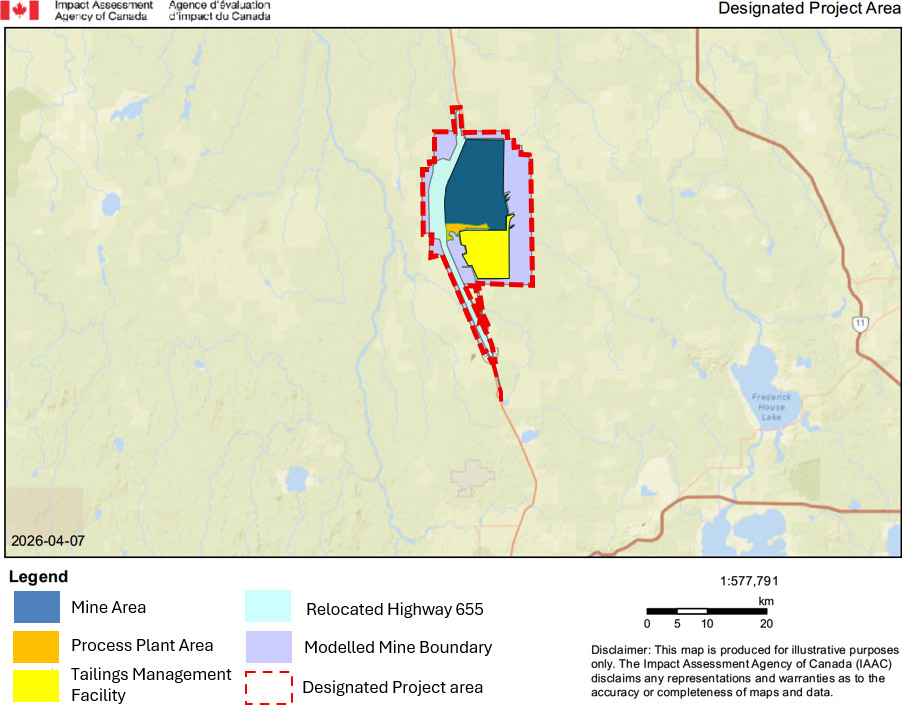
1.24 Modelled Mine Boundary means the modelled mine boundary area described in Figure 2 of schedule 1 of this document, that the Proponent owns, leases, or has agreements in place with the owners that enable the Proponent to restrict access to the public if required.
1.25 Monitoring means collecting, analyzing, and using information to measure the adverse federal effects of the Designated Project or to verify the accuracy of the impact assessment or to determine the effectiveness of any mitigation measure, or any of these combined.
1.26 Ontario Ministry of Citizenship and Multiculturalism means the Ministry of Citizenship and Culture established under Ontario's Ministry of Citizenship and Culture Act, RSO 1990.
1.27 Ontario Ministry of Natural Resources means the Ministry of Natural Resources established under the Ministry of Natural Resources Act, RSO 1990.
1.28 Operation means the phase of the Designated Project starting when commercial production takes place and continuing until decommissioning begins. This phase includes periods during which commercial production may temporarily cease.
1.29 Participate means to directly or indirectly assist or support initiatives through the provision of resources, including knowledge, time, data, access and other means that are economically and technically feasible and within the care and control of the Proponent.
1.30 Proponent means Canada Nickel Company and its successors or assigns.
1.31 Qualified individual means someone who, through education, experience and knowledge relevant to a particular matter, provides the Proponent with advice within their area of expertise. Knowledge relevant to a particular matter may include community and Indigenous knowledge.
1.32 Record means "record" as defined in section 2 of the Impact Assessment Act.
1.33 Relevant authority means federal, provincial and/or municipal authorities that are in possession of specialist or expert information or knowledge, or that have a responsibility for the administration of a law or regulation, with respect to the subject matter of a condition set out in this document.
1.34 Reporting year means January 1 to December 31 of the same calendar year.
1.35 Substantially begin means initiating the following components and activities required to carry out the Designated Project:
- 1.35.1 starting the construction of the tailings management facility, ore processing plant or excavation of the open pit.
Potential conditions
These conditions may be established for the sole purpose of the Decision Statement issued under the Impact Assessment Act. They do not relieve the Proponent from any obligation to comply with other legislative or other legal requirements of the federal, provincial, or local governments. Nothing in this document shall be construed as affecting what may be required of the Proponent to comply with all applicable legislative or legal requirements. In this document, a reference to a statute will include every amendment to it, every regulation made under it, every amendment made to a regulation made under it and any law enacted in substitution for, or in replacement of, it.
2 General conditions
2.1 The Proponent shall ensure that its actions in meeting the conditions set out in this document during all phases of the Designated Project are considered in a careful and precautionary manner, are informed by the best information and knowledge available at the time the Proponent takes action, including the most recent version of policies, guidelines and directives and community and Indigenous knowledge, are based on methods and models that are recognized by standard-setting bodies, are undertaken by qualified individuals, and have applied the best available economically or technically feasible technologies, or both.
Consultation
2.2 The Proponent shall, where consultation is a requirement of a condition set out in this document:
2.2.1 provide a written notice of the opportunity for the parties being consulted to present their views and information on the subject matter of the consultation;
2.2.2 provide all available information that is relevant to the scope and the subject matter of the consultation and a reasonable period of time not less than 30 days, or as otherwise agreed upon with the parties being consulted, to prepare their views and information;
2.2.3 undertake an impartial consideration of all views and information presented by the parties being consulted on the subject matter of the consultation; and
2.2.4 advise as soon as feasible in writing the parties being consulted on how the views and information received have, or have not, been integrated into the subject matter of the consultation by the Proponent and provide a justification as to why views and information received have not been integrated into the subject matter of the consultation.
2.3 The Proponent shall, where consultation with Indigenous groups is a requirement of a condition set out in this document, communicate with each Indigenous group with respect to the manner to satisfy the consultation requirements referred to in condition 2.2, including:
2.3.1 methods of notification;
2.3.2 the type of information, and the period of time to be provided when seeking input;
2.3.3 the process to be used by the Proponent to undertake impartial consideration of all views and information presented on the subject of the consultation; and
2.3.4 the period of time and the means to advise Indigenous groups of how their views and information were considered by the Proponent.
Follow-up requirements
2.4 The Proponent shall, where a follow-up program is a requirement of a condition set out in this document, develop the follow-up program taking into account any guidance documents provided by the Agency and determine, as part of the development of each follow-up program and in consultation with the parties being consulted during the development, the following information, unless already specified in the condition:
2.4.1 a description of the effects predictions and mitigation measures or both that will be evaluated through the follow-up program as required in the particular follow-up program condition;
2.4.2 the methodology, location, frequency, timing and duration of monitoring associated with the follow-up program;
2.4.3 the scope, content and frequency of reporting of the results of the follow-up program to the parties consulted for the development of the follow-up program;
2.4.4 the minimum frequency at which the follow-up program must be reviewed and, if necessary, updated;
2.4.5 the levels of environmental, health, social or economic changes relative to baseline that would require the Proponent to implement modified or additional mitigation measures, including instances where the Proponent may require Designated Project activities causing the change to be stopped;
2.4.6 the technically and economically feasible mitigation measures to be implemented by the Proponent if monitoring conducted as part of the follow-up program shows that the levels of change referred to in condition 2.4.5 have been reached or exceeded in order to return changes to levels below those referred to in condition 2.4.5;
2.4.7 the specific quantifiable end points that must be achieved before the follow-up program can end. Those end points should indicate that the accuracy of the impact assessment has been verified or that the mitigation measures are effective or both; and
2.4.8 the details of the results of the follow-up program to report to the Agency pursuant to condition 2.7.5.
2.5 The Proponent shall update the details determined for each follow-up program pursuant to condition 2.4 during the implementation of each follow-up program, at the minimum frequency determined pursuant to condition 2.4.4 and in consultation with the parties being consulted during the development of each follow-up program.
2.6 The Proponent shall provide the details of the follow-up programs referred to in conditions 3.3, 3.4, 5.7, 5.8, 5.9, 5.10, 7.7 and 7.8, including the information determined for each follow-up program pursuant to condition 2.4, to the Agency and to the parties being consulted during the development of each follow-up program prior to the implementation of each follow-up program. The Proponent shall also provide any update made pursuant to condition 2.5 to the Agency and to the parties being consulted during the development of each follow-up program within 30 days of the follow-up program being updated.
2.7 The Proponent shall, where a follow-up program is a requirement of a condition set out in this document:
2.7.1 implement the follow-up program according to the information determined pursuant to condition 2.4 and any requirement specified in conditions specific to each follow-up program;
2.7.2 conduct monitoring and analysis to verify the accuracy of the impact assessment as it pertains to the particular condition or to determine the effectiveness of any mitigation measure or both;
2.7.3 determine whether modified or additional mitigation measure(s) are required based on the monitoring and analysis undertaken pursuant to condition 2.7.2;
2.7.4 if modified or additional mitigation measure(s) are required pursuant to condition 2.7.3, develop and implement these mitigation measure(s) as soon as feasible and monitor them pursuant to condition 2.7.2. The Proponent shall notify the Agency in writing within 24 hours of any modified or additional mitigation measure being implemented. If the Proponent implements any additional or modified mitigation measure not previously submitted to the Agency pursuant to condition 2.4.6, the Proponent shall submit a detailed description of the measure(s) to the Agency within 7 days of their implementation; and
2.7.5 report all results of the follow-up program to the Agency no later than 3 months following each reporting year during which the follow-up program is implemented and, subject to information determined pursuant to 2.4.3, to the parties being consulted during the development of the follow-up program. As part of reporting the results of the follow-up program, the Proponent shall, for each follow-up program, provide an analysis and conclusion about the accuracy of the effects predictions made during the impact assessment or effectiveness of mitigation measures or both.
2.8 Where consultation with Indigenous groups is a requirement of a follow-up program, the Proponent shall discuss the follow-up program with each group and shall determine, in consultation with each group, opportunities for their participation and resources required to support their participation in the implementation of the follow-up program, including the conduct of monitoring, the analysis and reporting of follow-up results and whether modified or additional mitigation measure(s) are required, as set out in condition 2.7.
Annual reporting
2.9 The Proponent shall prepare an annual report for each reporting year that sets out:
2.9.1 the activities undertaken by the Proponent to comply with each of the conditions set out in this document;
2.9.2 how the Proponent complied with condition 2.1;
2.9.3 for conditions set out in this document for which consultation is a requirement, how the Proponent considered any views and information that the Proponent received during or as a result of the consultation;
2.9.4 the information referred to in condition 2.4 for each follow-up program and any update to that information made pursuant to condition 2.5;
2.9.5 a summary of the information reported pursuant to condition 2.7.5 for each follow-up program;
2.9.6 for any condition where implementation is stated to be dependent in whole or in part upon technical and/or economic feasibility, and the Proponent has determined it is not technically and/or economically feasible, a justification for that determination;
2.9.7 for any plan that is a requirement of a condition set out in this document, any update(s) to the plan that have been made during the reporting year; and
2.9.8 any modified or additional mitigation measure implemented or proposed to be implemented by the Proponent, as determined pursuant to condition 2.7.
2.10 The Proponent shall submit the annual report referred to in condition 2.9 to the Agency, including a plain language executive summary in both official languages, no later than 3 months following the reporting year to which the annual report applies.
2.11 The first reporting year for which the Proponent shall prepare an annual report pursuant to condition 2.9 shall start on the day the Minister of the Environment issues the Decision Statement pursuant to subsection 65 (1) of the Impact Assessment Act.
Information sharing
2.12 The Proponent shall publish on the Internet, or any medium which is publicly available, the annual reports and the executive summaries referred to in conditions 2.9 and 2.10, the reports related to accidents and malfunctions referred to in conditions 10.2.1 and 10.4.3, the communication plan for accidents and malfunctions referred to in condition 10.5, the schedules referred to in conditions 2.18 and 2.19, and any update or revision to the above documents, upon submission of these documents to the parties consulted for the respective conditions. The Proponent shall keep these documents publicly available for 25 years following their publication. The Proponent shall notify the Agency and Indigenous groups in writing of the availability of these documents within 3 business days of their publication.
2.13 When the development of any plan is a requirement of a condition set out in this document, the Proponent shall submit the plan to the Agency prior to its implementation, unless otherwise required through the condition.
Change of Proponent
2.14 The Proponent shall notify the Agency and Indigenous groups in writing no later than 30 days after the day on which there is any transfer of ownership, care, control or management of the Designated Project in whole or in part.
2.15 The Proponent shall notify the Agency in writing of any change to the contact information of the Proponent within 30 days of the change in contact information.
Change to the Designated Project
2.16 If the Proponent is proposing to carry out the Designated Project in a manner other than described in Schedule 1 of this document, the Proponent shall notify the Agency in writing in advance of carrying out the proposed activities. As part of the notification, the Proponent shall provide:
2.16.1 a description of the proposed change(s) to the Designated Project and the adverse federal effects that may result from the proposed change(s);
2.16.2 any modified or additional measure to mitigate any adverse federal effect that may result from the proposed change(s) and any modified or additional follow-up requirement;
2.16.3 an explanation of how, taking into account any modified or additional mitigation measure referred to in condition 2.16.2, the adverse federal effects that may result from the proposed change(s) may differ from the federal effects of the Designated Project identified during the impact assessment; and
2.16.4 the results of consultation with Indigenous groups on the proposed change(s), if the proposed change(s) may adversely affect those Indigenous groups including any views on the adverse federal effects referred to in condition 2.16.1 and on the modified or additional mitigation measures and follow-up requirements referred to in condition 2.16.2.
2.17 The Proponent shall provide to the Agency any additional information required by the Agency about the proposed change(s) referred to in condition 2.16, which may include the results of consultation with relevant authorities on the proposed change(s) and adverse federal effects referred to in condition 2.16.1 and the modified or additional mitigation measures and follow-up requirements referred to in condition 2.16.2.
Schedules
2.18 The Proponent shall submit to Indigenous groups, the Agency and any other relevant authorities, and no later than 60 days prior to the start of construction, a schedule outlining all activities planned to fulfill each condition set out in this document, including consultation activities pursuant to condition 2.2. This schedule shall indicate the commencement and estimated completion month(s) and year(s) and duration for each of these activities.
2.19 The Proponent shall submit to Indigenous groups, the Agency and any other relevant authorities, and no later than 60 days prior to the start of construction, a schedule outlining all activities required to carry out all phases of the Designated Project. The schedule shall indicate the commencement and estimated completion month(s) and year(s) and duration of each of these activities.
2.20 The Proponent shall submit to Indigenous groups, the Agency and any other relevant authorities in writing an annual update to the schedules referred to in conditions 2.18 and 2.19 every year no later than 3 months following each reporting year, until completion of all activities referred to in each schedule.
Record keeping
2.21 The Proponent shall maintain all records relevant to the implementation of the conditions set out in this document. The Proponent shall retain the records and make them available to the Agency during construction and operation, and for 25 years following their publication. The Proponent shall provide the records to the Agency upon demand within a timeframe specified by the Agency.
2.22 The Proponent shall retain all records referred to in condition 2.21 at a facility in Canada and shall provide the address of the facility to the Agency. The Proponent shall notify the Agency at least 30 days prior to any change to the physical location of the facility where the records are retained and shall provide the address of the new location to the Agency.
3 Fish and fish habitat
3.1 The Proponent shall develop, to the satisfaction of Fisheries and Oceans Canada and Ontario Ministry of Natural Resources and in consultation with Indigenous groups, and implement, prior to conducting any Designated Project activity requiring the removal of fish habitat, a protocol to salvage and relocate fish in waterbodies. As part of the protocol, the Proponent shall identify opportunities for Indigenous groups to participate in the salvage and relocation of fish including potential traditional use of salvaged fish.
3.2 The Proponent shall manage potential mine effluents, during the construction and operation phases of the Designated Project and in consultation with relevant authorities. In doing so, the Proponent shall:
3.2.1 continually refine the site water quality model with predictions for contaminants of potential concern, based on ongoing geochemical testing throughout construction and operation, and adapt the mine waste management plan prior to final closure; and
3.2.2 maintain space for contingency measures, including pump-back wells, interceptor well systems and hydraulic barrier systems, around sources of seepage including the tailings management facility, the impoundment facility and ore stockpiles.
3.3 The Proponent shall develop prior to the construction of the North Driftwood River Diversion Channel and in consultation with Indigenous groups and Fisheries and Oceans Canada and implement during the construction and operation of the North Driftwood River Diversion Channel, a follow-up program to determine the effectiveness of mitigation measures implemented to restore and develop fish habitat in the North Driftwood River Diversion Channel. In doing so, the Proponent shall:
3.3.1 assess whether the restored and developed habitat are functioning as the intended fish habitat; and
3.3.2 seek opportunities for the participation of interested Indigenous groups.
3.4 The Proponent shall develop, prior to construction and in consultation with Indigenous groups and relevant authorities, and implement, during all phases of the Designated Project, a follow-up program to verify the accuracy of the impact assessment and determine the effectiveness of mitigation measures with respect to adverse federal effects from the Designated Project on fish and fish habitat resulting from changes to surface water quality from sources of seepage, including the tailings management facility, impoundment facility and ore stockpiles. In doing so, the Proponent shall:
3.4.1 monitor concentrations of contaminants of potential concern, including chromium VI, cobalt, copper, nitrate-N, nitrite-N, selenium, uranium, vanadium and zinc at the seepage face in the North Driftwood River (including headwater lakes), West Buskegau River, and Jocko Creek;
3.4.2 demonstrate that concentrations level identified through monitoring referred to in condition 3.4.1 do not cause acute or chronic toxicity to fish; and
3.4.3 implement, if needed to avoid acute or chronic toxicity to fish, modified or additional mitigation measures pursuant to condition 2.7.4 and 3.2.2, such as pump-back wells, interceptor well systems, groundwater cutoff walls, and permeable reactive barrier systems. The Proponent shall submit these measures to the Agency before implementing them.
4 Migratory birds
4.1 The Proponent shall carry out the Designated Project in a manner that protects migratory birds and avoids capturing, killing, taking, injuring or harassing migratory birds or destroying, taking or disturbing their eggs, or damaging, destroying, removing or disturbing nests protected under the Migratory Birds Convention Act, 1994 and its regulations or the Species at Risk Act or both, while taking into account Environment and Climate Change Canada's Guidelines to avoid harm to migratory birds.
4.2 The Proponent shall determine, under the direction of a qualified individual and using non-intrusive methods selected based on habitat type, the presence, or likely presence of migratory bird nest(s) protected under the Migratory Birds Convention Act, 1994 and its regulations and residences protected under the Species at Risk Act that may be adversely affected by any Designated Project activity prior to initiating the activity.
4.3 The Proponent shall establish and delineate, as determined by and under the direction of a qualified individual, setback distances around the nest(s) and residence(s) whose presence or likely presence is determined pursuant to condition 4.2, within which that activity shall not occur while those nests are protected under the Migratory Birds Convention Act, 1994 and its regulations or the Species at Risk Act, or both. When establishing setback distances, the Proponent shall take into account Environment and Climate Change Canada's Guidelines to avoid harm to migratory birds.
4.4 The Proponent shall control Designated Project lighting, during all phases of the Designated Project, to mitigate attraction and disorientation of migratory birds while meeting operational, health and safety requirements, and taking into account the Convention on Migratory Species' International Light Pollution Guidelines for Migratory Species. As part of these measures, the Proponent shall:
4.4.1 use directional lighting that targets only the areas where lighting is needed;
4.4.2 optimize lighting design to reduce the total amount of lighting needed;
4.4.3 use shielded fixtures to reduce glare and light leakage in directions where light is not needed; and
4.4.4 use automatic sensors or strobe lighting in areas where continuous light is not needed.
4.5 The Proponent shall take all reasonable measures to prevent migratory birds from accessing sources of water that exceed the Canadian Council of Ministers of the Environment's Canadian Water Quality Guidelines for the Protection of Aquatic Life. Should migratory birds attempt to access these sources of water, the Proponent shall implement deterrents, while taking into account Environment and Climate Change Canada's Guide for Developing Beneficial Management Practices for Migratory Bird Conservation.
5 Health, social, and economic conditions of Indigenous Peoples
5.1 The Proponent shall develop, prior to construction and in consultation with Indigenous groups and relevant authorities and implement during all phases of the Designated Project, measures to promote safe, respectful and inclusive conduct in the workplace. These measures shall include actions to respond to call to justice 13.1 in Reclaiming Power and Place: The Final Report of the National Inquiry into Missing and Murdered Indigenous Women and Girls. As part of these measures, the Proponent shall:
5.1.1 implement a workplace anti-harassment, anti-bullying, anti-discrimination and anti-violence policy that contains gender-appropriate and gender-specific policies and processes, including sexual harassment and assault counselling and confidential and culturally sensitive care;
5.1.2 implement a diversity and inclusion policy;
5.1.3 implement a policy regarding the use and possession of drugs and alcohol in the workplace that prohibits use of, or being under the influence of, illicit drugs or alcohol during work hours;
5.1.4 develop mandatory cross-cultural awareness training in consultation with Indigenous groups, provide the training to employees of the Designated Project and contractors associated with the Designated Project and document the participation of employees of the Designated Project and contractors associated with the Designated Project in the training;
5.1.5 develop a Worker Code of Conduct that includes expectations and requirements in relation to the measures developed to promote safe, respectful and inclusive conduct in the workplace (including the policies referred to in conditions 5.1.1 and 5.1.2). The Proponent shall submit the Worker Code of Conduct to the Agency prior to construction and describe to the Agency how employees of the Designated Project and contractors associated with the Designated Project will be made aware of the Worker Code of Conduct and will be required to comply with it; and
5.1.6 develop and implement a whistleblower program for employee feedback and communication of concerns.
5.2 The Proponent shall develop, prior to construction and in consultation with Indigenous groups and relevant authorities, and implement during all phases of the Designated Project, a community feedback protocol for receiving and addressing complaints related to the exposure to noise, dust, air quality, water quality and other community safety concerns generated by the Designated Project. The Proponent shall provide the protocol to the Agency and Indigenous groups prior to construction and make the protocol publicly available online. As part of the protocol, the Proponent shall:
5.2.1 acknowledge receipt of any complaint within 48 hours;
5.2.2 identify how a person may provide a complaint, how the Proponent will record and address the complaint received, including ranking and responding to the complaint according to the anticipated level of impacts, and how the Proponent will implement modified or additional mitigation measures(s) and/or follow-up requirement(s) in response to the complaint; and
5.2.3 implement, as soon as technically feasible, any modified or additional mitigation measure and/or follow-up requirement that the Proponent deems necessary to respond to the complaint received;
5.2.4 inform Indigenous groups of mitigation measures implemented in response to their complaints;
5.2.5 develop reports summarizing community feedback and engagement statistics; and
5.2.6 share summary reports referred to in condition 5.2.5 with interested Indigenous groups, the Agency and relevant authorities.
5.3 The Proponent shall develop, prior to construction and in consultation with Indigenous groups, Indigenous Services Canada and other relevant authorities, and implement, during construction and operation, a Training and Employment Plan to increase opportunities for Indigenous Peoples, including Indigenous women and Indigenous businesses, to obtain skills and training, employment, procurement or contracting opportunities related to the Designated Project. The plan shall describe how the Proponent shall:
5.3.1 identify the prerequisite skills and training, both certified and uncertified, required to be employed by the Designated Project;
5.3.2 identify existing gaps in relation to the prerequisite skills and training referred to in condition 5.3.1 among Indigenous Peoples that may be employed by the Designated Project and describe measures under the care and control of the Proponent for filling these gaps. Measures shall include the provision of on-the-job training, apprenticeship and mentorship programs for Indigenous Peoples;
5.3.3 inform Indigenous groups, using targeted communication procedures designed in consultation with Indigenous groups, of the skills and training prerequisites referred to in condition 5.3.1 and of the measures referred to in condition 5.3.2 to achieve these prerequisites;
5.3.4 inform Indigenous Peoples of Designated Project–related employment and procurement opportunities, using targeted communication procedures designed in consultation with Indigenous groups;
5.3.5 consider procurement bids from qualified locally owned businesses, and give due consideration to bids submitted by businesses owned by Indigenous Peoples, Indigenous women owned companies, Indigenous members of the 2SLGBTQQIA+ community and Indigenous persons with disabilities; and
5.3.6 develop and implement measures to support the transition of Indigenous employees through the decline in employment and contracting opportunities during the Designated Project decommissioning and abandonment.
5.4 The Proponent shall develop, prior to construction and in consultation with Indigenous groups and relevant health authorities, and implement during all phases of the Designated Project, measures to mitigate the impacts of the Designated Project on the mental and physical well-being of Indigenous Peoples. In doing so, the Proponent shall establish a workplace health promotion program that includes worker mental and physical well-being, including addictions awareness training and access to addictions support services and remove barriers to seeking assistance, including by establishing a non-reprisal process for workers who access support services, to the extent permitted by applicable laws and any applicable workplace policies.
5.5 The Proponent shall provide personal protective equipment and associated safety training and information on where personal protective equipment should be worn within the Designated Project area to Indigenous groups and their members accessing areas within the Designated Project area for traditional and cultural purposes, upon request by Indigenous groups and their members.
5.6 The Proponent shall develop, prior to construction and in consultation with Indigenous groups and potentially affected municipalities, an Accommodation Plan for housing to mitigate the impact and adverse effects of the Designated Project workforce on the availability and affordability of housing for Indigenous Peoples. The Accommodation Plan shall include:
5.6.1 procedures for notification of, and engagement with, Indigenous groups and potentially affected municipalities regarding the Accommodation Plan;
5.6.2 measures to cooperate with Indigenous groups and municipalities to support housing plans and initiatives intended to address workforce accommodation requirements, taking into account different workforce scenarios over the life of the Designated Project; and
5.6.3 the results of an accommodations study to identify opportunities to participate in measures referred to in condition 5.6.2.
5.7 The Proponent shall develop, prior to construction and in consultation with Indigenous groups, Health Canada, and relevant authorities, and implement during construction and operation, a follow-up program to verify the accuracy of the impact assessment predictions and to determine the effectiveness of mitigation measures with respect to adverse federal effects on the health conditions of Indigenous Peoples from changes in air quality. As part of the implementation of the follow-up program, the Proponent shall:
5.7.1 determine the monitoring locations in consultation with Indigenous groups and in accordance with the Ontario Ministry of the Environment, Conservation and Parks' Operations manual for air quality monitoring in Ontario;
5.7.2 monitor, during construction and operation, at locations determined pursuant to condition 5.7.1, for exceedances of baseline levels for PM2.5, PM10, NO2, SO2 and any other contaminant s of concern determined in consultation with Indigenous groups;
5.7.3 if results from monitoring referred to in condition 5.7.2 indicate exceedances of baseline levels, develop and implement modified or additional mitigation measures in accordance to condition 2.7 to mitigate adverse federal effects on the health conditions of Indigenous Peoples from changes to air quality; and
5.7.4 for any feedback related to air quality received as part of the Community Feedback Protocol referred to in condition 5.2, the Proponent shall identify how feedback will be ranked and responded to according to the anticipated level of impacts.
5.8 The Proponent shall develop, prior to construction and in consultation with Indigenous groups, Health Canada, the Ontario Ministry of Environment, Conservation and Parks, and any relevant authorities, and implement during the construction, operation and decommissioning phases of the Designated Project, a follow-up program to verify the accuracy of the impact assessment and determine the effectiveness of mitigation measures with respect to adverse federal effects from the Designated Project on the health of Indigenous Peoples resulting from changes in fish consumed as country foods. As part of the implementation of the follow-up program, the Proponent shall:
5.8.1 Identify the species of fish consumed as country foods to be monitored;
5.8.2 establish thresholds for concentrations of arsenic and methylmercury in fish tissue, in species of fish identified pursuant to condition 5.8.1, in consultation with the Ministry of Environment, Conservation and Parks and Health Canada pursuant to condition 2.4.5;
5.8.3 monitor concentrations of arsenic and methylmercury in fish tissue, in species identified pursuant to condition 5.8.1 at representative upstream, downstream, and effluent discharge locations in the North Driftwood River and the West Buskegau River; and
5.8.4 provide the Ministry of Environment, Conservation and Parks data obtained from monitoring referred to in condition 5.8.3.
5.9 The Proponent shall develop, prior to construction and in consultation with Indigenous groups, Health Canada, the Ontario Ministry of Environment, Conservation and Parks, and any relevant authorities and implement during the construction, operation and decommissioning phases of the Designated Project, a follow-up program to verify the accuracy of the impact assessment and determine the effectiveness of mitigation measures with respect to adverse federal effects from the Designated Project on the health of Indigenous Peoples resulting from changes in surface water quality. In doing so, the Proponent shall:
5.9.1 establish a threshold for sulphates in consultation with the Ontario Ministry of Environment, Conservation and Parks and Health Canada pursuant to condition 2.4.5;
5.9.2 monitor concentrations of sulphates for exceedances of established threshold at representative upstream, downstream, and effluent discharge locations in the North Driftwood River and the West Buskegau River;
5.9.3 monitor concentrations of tungsten against the Provincial Water Quality Objectives at representative upstream, downstream, and effluent discharge locations in the North Driftwood River; and
5.9.4 if results from monitoring referred to in condition 5.9.2 and 5.9.3 exceed thresholds established in conditions 5.9.1 and 5.9.3, implement modified or additional mitigation measures. The Proponent shall submit these measures to the Agency before implementing them.
5.10 The Proponent shall develop, prior to construction and in consultation with Indigenous groups, and implement, during construction and the first five years of operation, a follow-up program to verify the effectiveness of the Training and Employment Plan with respect to providing opportunities for Indigenous Peoples to obtain skills and training, employment, procurement or contracting opportunities. As part of the implementation of the follow-up program, the Proponent shall monitor and annually report employment data for the Designated Project by identity factor(s) such as, gender and Indigenous identity, using disaggregated data provided as part of voluntary disclosures by employees and contractors.
6 Physical and cultural heritage, and structures, sites or things of historical, archaeological, paleontological or architectural significance to Indigenous Peoples
6.1 The Proponent shall develop, prior to construction and in consultation with Indigenous groups, and relevant authorities, and implement, during the construction, operation and decommissioning phases of the Designated Project, an Archeological and Cultural Resources Management Plan that includes a chance-find protocol for any previously unidentified structures, sites or things of historical, archaeological, paleontological or architectural significance discovered within the Designated Project area by the Proponent or brought to the attention of the Proponent. As part of the chance-find protocol, the Proponent shall:
6.1.1 immediately halt work at the location of a discovery, except for actions required to protect the integrity of the discovery;
6.1.2 delineate an area around the discovery as a no-work zone;
6.1.3 notify the Ontario Ministry of Citizenship and Multiculturalism immediately to receive guidance on recording, assessing and mitigating adverse effects on previously unidentified structures, sites or things of historical, archaeological, or paleontological significance;
6.1.4 notify the Indigenous groups and the Agency within 24 hours of the discovery, and identify opportunities for Indigenous groups to monitor archaeological works; and
6.1.5 develop and deliver mandatory training on chance find protocol and cultural awareness to all employees and contractors associated with the Designated Project. The training shall include identification of known sensitive locations within the Designated Project Area and procedures for implementing the chance-find protocol.
7 Current use of lands and resources for traditional purposes of Indigenous peoples
7.1 The Proponent shall develop, prior to construction and in consultation with Indigenous groups and relevant authorities, a communication plan to share information with Indigenous groups on adverse federal effects of Designated Project activities as they relate to impacts on the health conditions and current use of lands and resources by Indigenous Peoples. The Proponent shall implement and maintain the communication plan during all phases of the Designated Project. The communication plan shall include:
7.1.1 procedures for the Proponent to communicate information;
7.1.2 the location and timing of activities that may affect quality of experience to Indigenous uses of land for traditional purposes caused by changes in dust, noise or light within the Designated Project area and that may permanently or temporally affect access to the Designated Project area;
7.1.3 the dates and times of all regularly scheduled blasting events in the open pit to be conducted by the Proponent, any update to the blasting schedule for the open pit, or if the Proponent must conduct blasting activities in the open pit before 10:00 am or after 4:00 pm or on statutory holidays or days of cultural importance for Indigenous communities; and
7.1.4 the plain language results of follow-up programs and any modified or additional mitigation measures developed and implemented by the Proponent for each follow-up program as it relates to health conditions of Indigenous Peoples and current use of lands and resources by Indigenous Peoples.
7.2 The Proponent shall provide Indigenous groups with accompanied access through the Designated Project area during all phases of the Designated Project, for the purpose of accessing select areas for cultural purposes or for exercising rights, to the extent that such access and exercising of rights are safe. The Proponent shall advise Indigenous groups pursuant to condition 7.1 if access to the Designated Project area or any part thereof must be prohibited for safety reasons. In doing so, the Proponent shall:
7.2.1 develop, prior to construction and in consultation with Indigenous groups, and implement procedures for Indigenous groups to request and gain access through the Designated Project area; and
7.2.2 inform Indigenous groups of forthcoming clearing activities to support the gathering of plants prior to clearing, in accordance with the communication plan referred to in condition 7.1.
7.3 The Proponent shall prohibit Designated Project employees and contractors from fishing, hunting, trapping, plant gathering and using off-road vehicles for recreational purposes within the Designated Project area or using the Designated Project area to access surrounding areas for these purposes unless an employee or contractor is provided access by the Proponent for exercising Indigenous rights, to the extent that such access is safe.
7.4 The Proponent shall conduct, in consultation with Indigenous groups, progressive reclamation of areas temporarily disturbed by the Designated Project to progressively return physically disturbed areas to a state as close to baseline conditions as possible or better, as soon after the disturbance as feasible. In doing so, the Proponent shall:
7.4.1 identify plant species native to the region used for traditional purposes and that support habitat restoration; and
7.4.2 invite Indigenous groups to participate in the planting and reclamation activities.
7.5 The Proponent shall participate in the development, prior to construction and in consultation with Indigenous groups, of an intergenerational knowledge-transfer activity to mitigate adverse effects of the Designated Project on Indigenous cultural heritage and the current use of lands and resources. The Proponent shall participate in the implementation of the activity and provide a description of the activity to the Agency prior to its implementation. In participating in the development of the activity and in consultation with Indigenous groups, the Proponent shall:
7.5.1 determine the preferred format(s) of the knowledge-transfer activity; and
7.5.2 describe the roles, responsibilities and resources that the Proponent will provide to support the participation of youth and elders.
7.6 The Proponent shall manage, during the construction, operation and decommissioning phases of the Designated Project and in consultation with Indigenous groups, adverse federal effects to vegetation of Indigenous importance. In doing so, the Proponent shall:
7.6.1 identify plant gathering sites and vegetation of Indigenous importance located within the Designated Project area;
7.6.2 develop and implement an erosion and sediment control plan and a vegetation management plan; and
7.6.3 develop and implement an invasive species management plan, including equipment cleaning protocols and revegetation measures.
7.7 The Proponent shall develop prior to construction and in consultation with Indigenous groups, and implement during the construction, operation and decommissioning phases of the Designated Project, a follow-up program to verify the accuracy of the impact assessment and determine the effectiveness of mitigation measures with respect to adverse federal effects from the Designated Project on the current use of lands and resources for traditional purposes related to plant gathering. As part of the follow-up program, the Proponent shall:
7.7.1 monitor dustfall at sites identified in condition 7.6.1; and
7.7.2 if results of monitoring referred to in condition 7.7.1 indicate that dustfall at any of the sites identified in condition 7.6.1 exceed the Ontario Ministry of Environment, Conservation and Parks' Ambient Air Quality Criteria, notify Indigenous groups, in accordance with the communication plan referred to in condition 7.1.
7.8 The Proponent shall develop, prior to operations, and in consultation with Indigenous groups, and implement during operations, a follow-up program to verify the accuracy of the impact assessment and determine the effectiveness of mitigation measures with respect to adverse federal effects on the current use of lands and resources for traditional purposes of Indigenous peoples caused by Designated Project related hydrological changes. As part of the follow-up program, the Proponent shall:
7.8.1 identify wildlife habitat or vegetation used by species of importance for Indigenous peoples; and
7.8.2 monitor and verify groundwater levels, surface water levels, and wetland extent of hydrological changes and identify any unanticipated alteration of habitat features that support wildlife habitat or vegetation identified in condition 7.8.1.
8 Indigenous monitors
8.1 The Proponent shall retain, prior to construction, the services of Indigenous monitor(s) to participate in the implementation of follow-up programs. Prior to retaining the services of Indigenous monitor(s), the Proponent shall undertake a collaborative process to determine, in consultation with Indigenous groups, the scope, purpose and objectives of the participation of Indigenous monitor(s). The Proponent shall provide this information to the Agency prior to construction with the permission of the respective Indigenous group. As part of that process, the Proponent shall determine:
8.1.1 how each Indigenous monitor shall be involved in monitoring their areas of interest, including the location, frequency, timing and duration of their participation;
8.1.2 how Indigenous monitors shall be selected; and
8.1.3 how the Proponent shall support the participation of Indigenous monitors.
9 Independent environmental monitor
9.1 The Proponent shall retain, prior to the start of construction and in consultation with Indigenous groups, the services of a third-party independent environmental monitor, who is a qualified individual as it pertains to environmental monitoring in Ontario, to independently observe and record on the implementation of the conditions set out in this document during construction and to report findings to the Proponent, Indigenous groups and the Agency.
9.2 The Proponent shall require the independent environmental monitor to report to the Proponent, Indigenous groups and the Agency, in writing, prior to or concurrent with reporting to the Proponent, if, in their view, any Designated Project activity does not comply with any condition set out in this document. The Proponent shall require the independent environmental monitor to report the information to Indigenous groups and the Agency at a frequency and in a format determined in consultation with Indigenous groups and the Agency, respectively.
10 Accidents and Malfunctions
10.1 The Proponent shall take all reasonable measures to prevent accidents and malfunctions that may result in adverse federal effects and mitigate any adverse federal effects from accidents and malfunctions that occur. In doing so, the Proponent shall:
10.1.1 design, construct and operate the tailings management facility containment structures taking into account the Canadian Dam Association's Dam Safety Guidelines and the Mining Association of Canada's Guide to the Management of Tailings Facilities;
10.1.2 design and construct Designated Project infrastructure to meet applicable codes and standards that address wildfires, landslides, slope stability, and extreme weather events;
10.1.3 design, construct and maintain water management structures to accommodate, at a minimum, a 1-in-100-year flood event, based on historical climate data and projected future changes in extreme rainfall;
10.1.4 establish fire and spill prevention plans;
10.1.5 restrict vehicle and equipment refueling and servicing to designated areas with spill containment;
10.1.6 use secondary containment systems with sufficient capacity to contain all stored hazardous materials; and
10.1.7 provide training to Designated Project employees on malfunction and accident prevention and response.
10.2 The Proponent shall develop, prior to construction and in consultation with Indigenous groups and relevant authorities and implement an accidents and malfunctions prevention and response plan in relation to each phase of the Designated Project. The accidents and malfunctions prevention and response plan shall include:
10.2.1 a description of the types of accidents and malfunctions that may cause adverse federal effects during any phase of the Designated Project;
10.2.2 the measures to be implemented in response to each type of accident and malfunction referred to in condition 10.2.1 to mitigate any adverse federal effect caused by the accident or malfunction, taking into account Environment and Climate Change Canada's National Wildlife Emergency Response Framework; and
10.2.3 for each type of accident and malfunction referred to in condition 10.2.1, the roles and responsibilities of those involved in the implementation of the measures referred to in condition 10.2.2, including the Proponent, each relevant authority, and any other party that may be called upon to respond to an accident or malfunction.
10.3 The Proponent shall maintain the accidents and malfunctions response plan referred to in condition 10.2 up to date during the phase to which it pertains. The Proponent shall submit any updated accidents and malfunctions response plan to the Agency and to parties consulted for the development of the plan within 30 days of the plan being updated.
10.4 In the event of an accident or malfunction with the potential to cause adverse federal effects, including an accident or a malfunction referred to in condition 10.2.1, the Proponent shall immediately implement the measures appropriate to remedy the accident or malfunction, including any measure referred to in condition 10.2.2, and shall:
10.4.1 notify, as soon as feasible, relevant authorities with responsibilities related to emergency response, including environmental emergencies, in accordance with applicable legislative and regulatory requirements
10.4.2 notify, as soon as feasible and pursuant to the communication plan referred to in condition 10.5, Indigenous groups of the accident or malfunction, and notify the Agency in writing no later than 48 hours following the accident or malfunction. When notifying Indigenous groups and the Agency, the Proponent shall specify:
10.4.2.1 the date and time when and location where the accident or malfunction occurred;
10.4.2.2 a summary description of the accident or malfunction;
10.4.2.3 a list of any substance potentially released into the environment as a result of the accident or malfunction; and
10.4.2.4 a description of the relevant authorities notified and of the relevant authorities engaged in response to the accident or malfunction.
10.4.3 submit a written report to the Agency no later than 60 days after the day on which the accident or malfunction occurred. The written report shall include:
10.4.3.1 a detailed description of the accident or malfunction and of its adverse federal effects;
10.4.3.2 a description of the measures that were taken by the Proponent to mitigate the adverse federal effects caused by the accident or malfunction;
10.4.3.3 any view from Indigenous groups and advice from relevant authorities received with respect to the accident or malfunction, its adverse federal effects and the measures taken by the Proponent to mitigate these adverse federal effects;
10.4.3.4 a description of any residual adverse federal effect and a description of any modified or additional measure required by the Proponent to mitigate or monitor residual adverse federal effects;
10.4.3.5 a description of any changes made to avoid a subsequent occurrence of the accident or malfunction; and
10.4.3.6 details concerning the implementation of the accidents and malfunctions response plan referred to in condition 10.2.
10.5 The Proponent shall develop, in consultation with Indigenous groups, a communication plan for accidents and malfunctions in relation to the Designated Project. The Proponent shall develop the communication plan prior to construction and shall implement and keep it up to date during all phases of the Designated Project. The plan shall include:
10.5.1 the geographic areas of possible accidents and malfunctions where Indigenous groups would like to receive notifications;
10.5.2 the types and thresholds of accidents and malfunctions requiring the Proponent to notify the Indigenous groups;
10.5.3 the information to be included in the notifications to support community preparedness and response;
10.5.4 the method and frequency of notifications, including opportunities for Indigenous groups to assist in accident or malfunction response efforts; and
10.5.5 the names and contact information of the Proponent and Indigenous group representatives for the purposes of notification pursuant to condition 10.5.3.
Description of the Designated Project
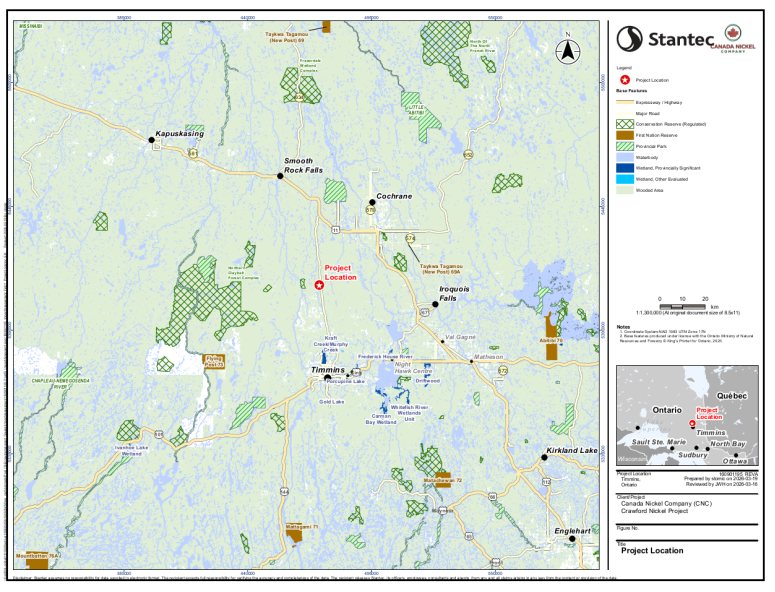
The Designated Project is the construction, operation, decommissioning and abandonment of an open pit nickel-cobalt mine and on-site ore processing facilities (mill) that is located approximately 42 kilometres (km) north of Timmins, Ontario. The Designated Project location is shown on Figure 1.
The Designated Project has an extraction capacity of up to approximately 88 million tonnes of ore per year (approximately 240,000 tonnes per day) and a mill ore input capacity of approximately 44 million tonnes per year (approximately 120,000 tonnes per day) over approximately 41 years of operation. The Designated ProjectArea, shown in Figure 2, is approximately 118 km2.
The Designated Project Area is subdivided into five sections: the Process Plant Area, the Mine Area, the Tailings Management Facility Area, the Modelled Mine Boundary Area and the Incidental Activities Area.
Process Plant Area
The Process Plant Area, shown on Figure 2, includes the following components and associated physical activities:
- process plants;
- primary and secondary crushing plants;
- concentrate loadout building;
- stockpile feed conveyors;
- crushed ore stockpiles;
- water management structures and water treatment facilities that include water diversions, collection ditches and ponds and pipes;
- explosives magazine with a minimum setback of 270 metres from other buildings and explosive pad;
- freshwater intake (pumping wells);
- fuel farms including fuel tanks and fuel stations with containment infrastructure;
- tailings distribution system;
- connection to transmission line and substation;
- onsite electrical distribution system;
- vehicle maintenance workshop, vehicle parking, and wash stations;
- haul and service roads;
- sewage treatment;
- laydown areas; and
- offices, gatehouse, warehouses, and workshops, medical facility, laboratories, maintenance facilities and other associated ancillary infrastructure.
Mine Area
The Mine Area, shown on Figure 2, includes the following components and associated physical activities:
- open pit;
- rock impoundment, sand and till impoundment and clay impoundment;
- West and East stockpiles;
- reclaim stockpiles;
- haul and service roads;
- onsite electrical distribution system;
- sewage treatment;
- laydown areas; and
- water management, erosion and sediment control structures, and water treatment facilities that include water diversions, collection ditches and ponds and pipes.
Tailings Management Facility (TMF) Area
The TMF Area, shown on Figure 2, includes the following components and associated physical activities:
- perimeter dam to impound the tailings, and ancillary infrastructure;
- reclaim stockpiles;
- deflector berm;
- freshwater intake (pumping wells);
- tailings distribution system;
- haul and service roads;
- onsite electrical distribution system;
- laydown areas;
- sewage treatment; and
- water management structures and water treatment facilities that include water diversions, collection ditches and ponds and pipes.
Modelled Mine Boundary Area
- The Modelled Mine Boundary area, shown on Figure 2, include the areas where the Proponent owns, leases, or has agreements in place with the owners that enable the Proponent to restrict access to the public.
Incidental Activities Area
The Designated Project includes the following additional components and incidental activities:
- proposed rail spur line to be constructed by Canada Nickel Company that will be owned, operated and maintained by Ontario Northland Railway (ONR) connecting the Process Plant to the existing ONR spur line;
- the re-aligned segment of Highway 655 to be constructed by Canada Nickel Company that will be owned, operated, and maintained by Ontario Ministry of Transportation; and
- the relocated section of 500 kV transmission line that will be owned, constructed, operated, and maintained by Hydro One Networks Incorporated.